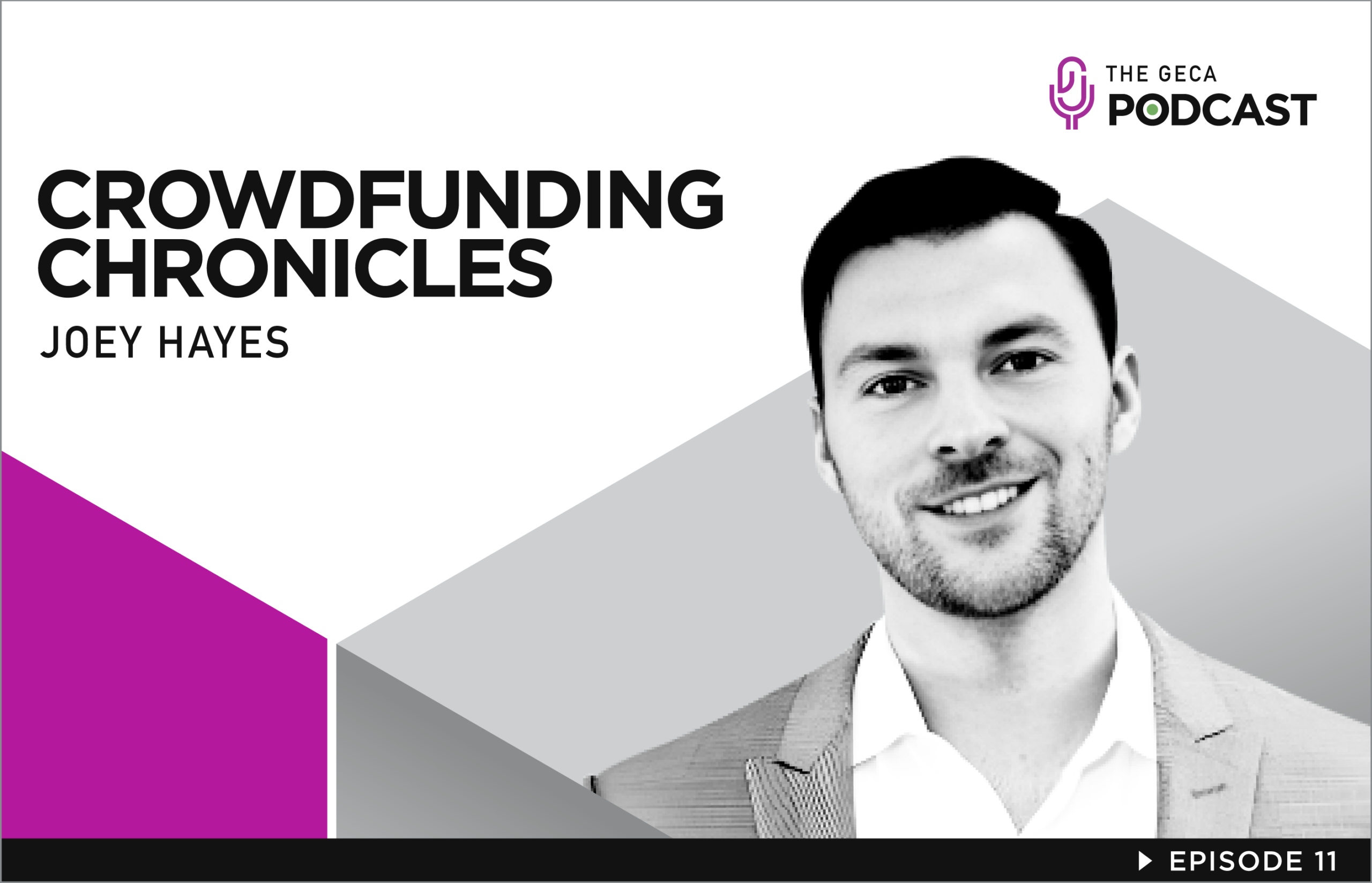
Unlocking Cap Table Value: Post-Raise Investor Activation with Joey Hayes | GECA Podcast
Most founders celebrate when they hit their funding goal. Then communication drops off a cliff. What if the biggest asset you gained wasn’t the capital – but the community of 500+ investors sitting in a spreadsheet you’ve never opened?
Join Andy Field in conversation with Joey Hayes, founder of THRU and investor in 65+ startups, as he reveals why post-raise investor activation is crowdfunding’s most overlooked opportunity. Joey shares how he discovered that roughly 10% of any cap table can significantly impact business growth – if founders know how to ask.
From his failed first business Mac Shack to building a platform that transforms passive backers into active growth partners, Joey breaks down why founders struggle post-raise, how to identify high-opportunity investors, and the one thing every founder should do tomorrow if they haven’t communicated with investors in 30 days.
Key insights:
- Why engaged investors are 3x more likely to reinvest
- How 20-25% of investors will actively help – if asked properly
- The difference between broadcasting to 500 people and activating the right 50
- What platforms should do differently to support post-raise engagement
- How AI will transform founder-investor relationships in the next 2-3 years
Capital raises companies. Activated communities build them.
ALSO AVAILABLE ON


Share this article


[00:00:00] Welcome to the GECA Podcast, powered by the Global Equity Crowdfunding Alliance. Dive into the realm of borderless equity crowdfunding, where we bring the world’s top experts and industry leaders directly to you – discussing innovations that are redrawing the boundaries of finance. Ready to expand your horizons?
Here’s your host, Andy Field.
Andy Field (Host): Hello everybody, and welcome to the GECA Podcast. Today we’re diving into a part of the equity crowdfunding and startup journey that’s often overlooked—and it’s actually quite important—and that’s what happens after the raise.
So my guest today is Joey Hayes. Joey’s an entrepreneur, investor, and the founder of THRU—that’s T-H-R-U—a company focused on helping founders unlock the real value hidden in their cap tables.
Joey’s career began in global commercial roles at companies like IHG, Hyatt, Hilton, and Booking.com before he made the leap into entrepreneurship and investing. In 2021, he launched the first of his bootstrap businesses, Mac Shack. This was a journey that sparked one of the most important insights of his career.
He’s spoken about that many times—and that is: for many founders, isolation and underutilized investor support can be just as dangerous as a lack of capital.
Looking across his portfolio of more than 65 startup investments, Joey noticed a recurring pattern: founders raising money successfully, but then struggling to engage and leverage their investors once the campaign ended.
And what followed was the creation of THRU. THRU is a platform—and a philosophy—built around turning passive backers into active contributors to growth.
Now at GECA, we often focus on how to raise capital more efficiently across borders. And Joey is going to remind us that raising capital is just the beginning—and what founders and platforms do next may matter even more.
Today we’re going to explore how investor engagement really works, why so much value remains untapped, and how activating those communities could reshape the future of equity crowdfunding.
Joey, it’s great to have you with us. Welcome.
[00:02:00]
Joey Hayes (Guest): Beautifully said, Andy. Thank you so much.
Andy Field (Host): No problem. And Joey’s actually based in Amsterdam today. I’ve got a big woolly jumper on here—it’s pretty cold. Hopefully it’s not too bad for you where you are.
Joey Hayes (Guest): I find if I wear summer gear, I feel warmer. So that’s my strategy.
Andy Field (Host): No, that’s a good one. That’s a good one.
Joey Hayes (Guest): Right there with you.
Andy Field (Host): Fantastic, Joey. Let’s get right in. You’ve worked across global hospitality and tech giants. What first pulled you into startups and investing?
[00:03:00]
Joey Hayes (Guest): Yeah, so my interest in crowdfunding actually started when I was in grad school. I was at NYU, studying sustainable real estate development, and I was able to do a project on the first crowdfunded skyscraper in Bogotá.
It was a project that I really dove into, and I loved it. I became really interested in crowdfunding then.
Then later, when I moved to Amsterdam during COVID, I got really into crowdfunding again—it became my little obsession, my COVID obsession. While people were buying on Amazon, I was investing small-ticket amounts in companies, for better or for worse.
But I really got into the crowdfunding space and investing in startups. Then I started my own business—my first business—Mac Shack, my restaurant.
After that, I started joining a lot of founder communities, both online and in person. That’s really when I started to love what these communities were about—how helpful they were—and how interesting it was to understand the whole entrepreneurial journey.
And that’s what kind of got me obsessed with trying to help founders make it easier for them.
Andy Field (Host): Yeah. Okay—so going from corporate to becoming the founder, and investor at the same time—how did that shape how you see the ecosystem today?
[00:04:00]
Joey Hayes (Guest): Yeah, it was—like you said in the intro—starting a business was quite a lonely journey, but it didn’t really have to be.
It was fun and fulfilling, but what I found was that there was all this support around me. For example, I would get out of work, then go to my restaurant and start working on all the problems that a restaurant has.
I was in charge of the business side. My partner was involved in the operations and the cooking. And I would sit there and bake in my problems, for lack of a better word, and just try to determine who in my support network was there to help me.
And I realized there was a lot of—not conflict—but friction between knowing I needed help, and actually getting that help from the people around me.
That got me into: one, getting better at entrepreneurship and realizing that asking for help is actually a huge part of being a successful entrepreneur.
And two, it’s a skill a lot of people don’t have in general—but a lot of entrepreneurs don’t have it because we just want to do it all ourselves.
So that made me a bit obsessed with trying to help myself get better help from the people around me—and then help others do that too.
And when I was determining what kind of company I wanted to start, I struggled with it for a while. Then one day I was like: crowdfunding.
I looked at my portfolio and thought: none of these founders—none of these startups—have ever really asked me for help.
Andy Field (Host): Even someone who’s got an active interest in the business.
[00:06:00]
Joey Hayes (Guest): Yeah—someone with an active interest.
Actually, I have an interesting story for you, Andy. I was at a hospitality tech conference in Paris, and one of the founders I invested in was there—one of the best startups I invested in. I was really excited to meet him. His name was Luca.
I went up to him after his talk and said, “Hey Luca, I was an investor in your Wefunder campaign a little over a year ago.”
And he was like, “Oh man, that’s so great.” Then he said, “What the hell are you doing here in Paris at this hospitality tech conference?”
And I said, “I work for Booking.com.”
His eyes lit up and he was like, “You work for Booking? I’ve been looking for a Booking.com contact for months now.”
And I’m like, “Luca—I’ve been on your cap table for over a year. My bio says that, my LinkedIn says that.” And he’s a super dialed-in founder—very dialed in.
So I thought: if he’s missing it, everyone’s probably missing it.
And the more founders I spoke to, the more I noticed this wasn’t something they really planned for. After the raise, cap tables collect all this money—but post-raise, it becomes a void.
So that’s when I decided this is something I could really help with in the crowdfunding ecosystem, but also just with startups and founders in general.
Andy Field (Host): So it’s about your experience with Mac Shack. I know you’ve spoken about that not really working out so well. Can you give a bit more insight into what that period taught you about being a founder? You’ve already mentioned isolation, and the fear of asking for help. Did you recognize absolutely that you needed help?
[00:07:00]
Joey Hayes (Guest): Oh, absolutely. I recognized that. I think everyone needs help. It was a matter of determining how to ask for help, when to ask for help, and who the best person was to help.
That’s what I really struggled with—cutting through all the noise.
A lot of times, by the time I asked for help, I was in the red zone. I’d already tried everything else, and then you’re asking in a sea of panic—and that’s never nice for either person.
So I learned to be more proactive: understand what you need help with, why, and when. Then go to that person and say, “Hey, I really need help with this.”
And try not to do it in panic mode—where you put pressure on them.
One thing I learned is: when you’re asking someone for help, you have to make it as easy on that person as possible.
Also—this was a mindset shift—someone told me (and I forget who), but: when you don’t ask for help, you don’t give someone the opportunity to help you.
So when you don’t ask, you’re actually taking something away from them. That changed everything for me.
Andy Field (Host): Yeah, that’s a great way of looking at it. And I think entrepreneurs by their very nature are probably not the best people in the world to automatically ask for help. They like to think they understand their own business and nobody knows it better—and of course they don’t.
But there’s no harm and no shame. It can only be an advantage—getting the right people to help with the right problem.
How different do you think your journey with Mac Shack might have been if you’d had stronger engagement from people helping you?
[00:09:00]
Joey Hayes (Guest): It would’ve been a lot different. Honestly though, I don’t think it would’ve succeeded either way.
Andy Field (Host): Oh, okay.
Joey Hayes (Guest): Because it wasn’t the right business for me. It was a really great first business, but in the end it wasn’t. Even if it did succeed, I think I would’ve been pretty miserable, to be honest with you.
But I think my takeaways from that are exactly what was supposed to happen—and it was supposed to lead me onto this.
There are a lot of people out there in similar situations, where they have businesses that are struggling—or they’re struggling—and they don’t know how to capitalize on the networks they have, whether it’s investors, friends, or family.
Where I think this is most beneficial is crowdfunding, because you have hundreds or thousands of people who are literally invested in your business—and they’ve already given you the money, Andy. That’s the hard part, right?
Andy Field (Host): That’s right—they bought into you.
[00:10:00]
Joey Hayes (Guest): Exactly. Asking them to share a referral code or intro somebody—that’s probably the easy part.
And a big part of it is riding the momentum of the raise. You come off the raise and everyone’s excited—especially if you hit your target—and then communication drops off a cliff.
Momentum is so important in business, in everything. If you can continue that momentum after the raise and capitalize on the knowledge and skills of your investors, you’ll be more successful, keep them engaged, and overall build a better business.
Andy Field (Host): That makes perfect sense. So moving on to what you’re doing with THRU now—why do you think founders struggle so much with activating their investors after the raise? Is it that crowdfunding is seen as finished once the capital has been raised?
[00:11:00]
Joey Hayes (Guest): A couple things.
One is: they’re exhausted. The raise is exhausting—often more work than they expected. By the time it’s over, they’re relieved and want to get back to building their business, which is fair.
Another part is: they don’t plan for the post-raise. There’s so much planning for the raise itself, and post-raise gets kicked down the road.
Also, they often don’t have the people for it. The founder or CEO ends up doing it, and after the raise they want to do something else. If they don’t have a community manager (which I think is so important), it’s hard.
It’s mostly lack of planning, exhaustion, and lack of strategy. There aren’t many people focused on post-raise. Most firms and consultancies focus on the raise itself.
So it’s a lack of support—and those things combined make the transition difficult.
Andy Field (Host): And what sets crowdfunding companies apart—in a positive way—is they’ve got this marketing asset: a community of people who’ve already bought into the business. They’ve actively invested, so they believe in the story.
Approaching them and activating them can only be beneficial—they’re ready-made ambassadors.
[00:13:00]
Joey Hayes (Guest): Exactly. If you go up to any company and say, “I’ll give you 1,000 people who want to help your business grow—who are truly invested in you succeeding,” they’d say, “Oh my God—give me the names, give me the emails.”
And you already have them.
Another interesting part is: founders don’t realize that often the people investing in them are in the industry themselves. It resonates with them because they understand it.
Like, I tend to invest in hospitality companies and hospitality tech because that’s my field. A lot of founders will find, when they look through their cap table, that many investors are in the same industry—and are in a great position to help.
Andy Field (Host): So their main driver may not be a set return within a certain timeframe—it could be genuine interest and expertise, which makes them well-placed to help.
You mentioned patterns across 65+ investments. What kept repeating?
[00:15:00]
Joey Hayes (Guest): Some founders were good at the engagement piece—maybe about half. They kept investors informed by adding them to marketing emails or posting monthly updates on Wefunder, StartEngine, etc.
But hardly any were meeting the activation piece—and many didn’t have the mindset that investors are a growth channel. They see them as a source of capital, then it’s a hard stop.
I was talking to a founder the other day with 3,000 investors. He said, “Joey, I don’t know why we didn’t think of this. Why don’t we do more with these evangelists who can amplify our marketing? Refer customers? Intro partnerships?”
It’s never seen through a commercial lens—only through a capital-raise lens.
Also: engaged investors are about three times more likely to reinvest.
A lot of founders put too much emphasis on what to say. They overthink it. Sometimes they say they have nothing to say.
But people just want to know what’s going on. The worst thing is silence.
There’s a lot of underthinking and overthinking—not much middle-ground thinking.
Andy Field (Host): And you’ve answered my next question: the biggest misconception about the cap table is that it’s “just investors,” when actually it’s a whole group of ambassadors with aligned incentives.
[00:18:00]
Joey Hayes (Guest): Exactly. Even on the capital front—you should look at your investor base as a way to get more investors, even institutional investors.
When we go through cap tables, we see retail and accredited investors who work for investment firms and literally say, “Reach out if you’re looking for more capital.”
Wefunder does a good job collecting bios and asking investors during checkout what they can do to help—but it’s mostly ignored.
Because it’s intimidating: you download a spreadsheet with 500 investors and think, “I’m not sifting through this.” So it goes in a drawer.
What we do is sift through it for you. We determine who’s best suited to help and who’s willing.
We use platform data and our own co-created survey with the founder. The survey also helps identify who’s extra motivated—because they actually fill it out.
We’re seeing around 20–25% of investors take that step, and about 10% become high-opportunity investors who could do something significant for the business.
Andy Field (Host): That’s interesting. So how does THRU do things differently from typical investor relations tools?
[00:20:00]
Joey Hayes (Guest): We don’t have our own platform. The last thing anyone needs is another platform.
We ask for access to the backend of whatever tool they use so we can download reports. We co-create the survey using whatever tool the startup prefers—Google Forms, Jotform, etc.
We take the data, use AI plus manual lookup, and cross-reference it with the founder’s goals.
Then we produce a simple report—usually a Google Doc—with recommendations and insights, and we go through it together to decide next steps.
We also segment investors by industry, by engagement level, and by preference: “Do you want to be supportive, active, or silent?” We don’t want to bother people who don’t want to engage.
A useful insight we often uncover: who in the investor base is already a customer. Many founders have no idea. If 30% of your investors aren’t customers, you can run a targeted campaign to convert them—often with good success.
We also help with outreach strategy. A lot of times you don’t lead with “Can you help me?” You start with advice: “Based on your background, how would we break into this industry?” People love giving that advice—and then you build a relationship.
Ultimately, it’s about nurturing high-value opportunities in your cap table.
Our next phase is productizing this: understanding the founder’s tech stack, detecting opportunities and challenges in real time, ranking which investors can help, and reducing friction from “I need help” to “I’ve asked for help,” even drafting communications to support the process.
Andy Field (Host): That’s pragmatic. But even when founders want to do this, they can be limited by resources, money, and energy. Where do you get stuck when engaging investors?
[00:24:00]
Joey Hayes (Guest): Sometimes people say a lot and then don’t respond—and that’s okay. We usually give it three attempts, and then we move on.
Long-term, it’s valuable to understand who really is founder-focused—who wants to help versus who just says they will.
Also, don’t email-blast your whole cap table. Take the top 20 and do dedicated, personalized outreach. Call them out respectfully: “On the survey you said you were willing to help with this—I’m reaching out.”
And have a specific ask. Don’t say, “I need intros to the luxury hospitality market.” You’ll get crickets. Find the right people and ask specific questions.
If you get them on the phone, have an agenda—don’t waste their time or yours.
One founder told me, “Joey, this is great, but it’s overwhelming.” So we prioritized: for example, start with someone who invested 25,000 rather than 500. That’s not always right, but we learn as we go.
We also enrich the data with manual LinkedIn research to make it more robust and increase chances of success.
Andy Field (Host): If I was an investor and the founder approached me that way, I’d see it as proactive—trying to make my investment work.
So how should platforms support post-raise activation? Is it more platforms collecting the right data—or is there more they can do?
[00:28:00]
Joey Hayes (Guest): More platforms should do it, yes—offer templates for monthly investor updates, reminders to send updates.
KingsCrowd just launched a free investor relations tool—things like that help.
But the key is education: move investor engagement from a chore or compliance issue into something profitable. Founders need that mindset shift: “You will lose money if you don’t do this.”
Crowdsourcing support is one of the biggest reasons founders choose crowdfunding—so not capitalizing on it is a waste.
As an industry, we haven’t done well enough at that. We need stewardship—everyone pushing the same narrative.
We’ve spent the last 10 years building access—more investors, more founders. Now we need the next phase of professionalization: post-raise retention and investor experience, so investors come back. We’ve lost a decent amount of people along the way.
Andy Field (Host): And we always come back to education in these conversations: the work doesn’t end when the raise ends.
Looking ahead—how do you see founder–investor relationships evolving over the next five years?
[00:30:00]
Joey Hayes (Guest): I’m hoping AI and automation play a bigger role—that’s what we’re banking on at THRU.
Detect opportunities and challenges, match them to the cap table, and identify who can help.
Also, AI can help with the “chore” work: meeting notes, monthly summaries, drafting updates—so it’s less daunting.
I’m very clear: you need engagement before activation. And you can’t ignore the rest of the cap table. It’s the 80/20 rule: focus on the top 20%, but still communicate broadly.
I think platforms will do more—we’re already seeing it. There may be legislation in the US increasing the amount companies can raise.
But overall, the experience of both investor and founder needs to improve. I hope it only gets better from here: crowdfunding grows, people have better experiences, they come back, and they tell friends and family.
Andy Field (Host): Perfect. So to sum up: if founders listening today could change one thing tomorrow about how they operate post-raise, what would it be?
[00:33:00]
Joey Hayes (Guest): I’d ask: when’s the last time you reached out to your investors? And what do you know about your investors—your cap table?
If someone asked you, “How do I get an X, Y, Z introduction?” would you know who to go to on your cap table? Do you know who’s on there?
So: one, look at your investor insights. Two, look at when you last communicated.
If you haven’t communicated in more than 30 days—do it. There’s really no bad communication. Even saying, “We’re building a communication strategy, and here’s what you can expect,” is fine.
Just say something.
Andy Field (Host): Great. To finish—where can people learn more about THRU and your work? And do you work globally?
[00:34:00]
Joey Hayes (Guest): Yeah—we’ll work with anybody.
We’ve focused mainly in the US because we just started, and I’ve been focusing on my investments, but we’re scaling. Anyone around the world—we’re happy to help.
LinkedIn is the best way to reach me—maybe you could put the link in the show notes. And also our company page.
Our website is: https://www.comethru.co/
There’s a “Request early access” button that goes straight to me. We’ll determine if it’s the right fit.
And like I said—we’re consulting, and it’s just me right now, so there is some bandwidth limitation. But we’re trying to help as many people as possible.
Reach out, and we’ll determine the best way to help.
[00:35:00]
Andy Field (Host): Fantastic, Joey. Thanks so much. It’s a really powerful—and practical—conversation.
What really stands out is the reminder that capital alone doesn’t build great companies. It’s the people who do that.
And when founders learn how to truly activate their investor communities, they unlock not just funding, but momentum, insight, and advocacy.
And for GECA, this is a crucial part of the puzzle. Building better cross-border markets isn’t only about regulation and platforms—it’s also about what happens inside each cap table once the raise is complete.
Thanks again, Joey. That was a fantastic conversation. We’ll be sure to connect people with you who like what you’re doing.
Joey Hayes (Guest): Thank you, Andy—and thank you for everything you do for the industry and with GECA. I’m excited to work with you moving forward, and I really appreciate you giving me the opportunity today.
Andy Field (Host): No problem at all. And to our listeners—thanks for tuning in. Stay with us for future episodes as we continue to explore the people, the policies, and the platforms that are unlocking crowdfunding without borders.
Don’t forget to follow GECA for more conversations with the people shaping the future of global equity crowdfunding. And visit thegeca.org to learn more about our mission, our growing global supporter base, and how you can get involved.
Thanks everyone, and we’ll see you next time.
[End of Transcript]