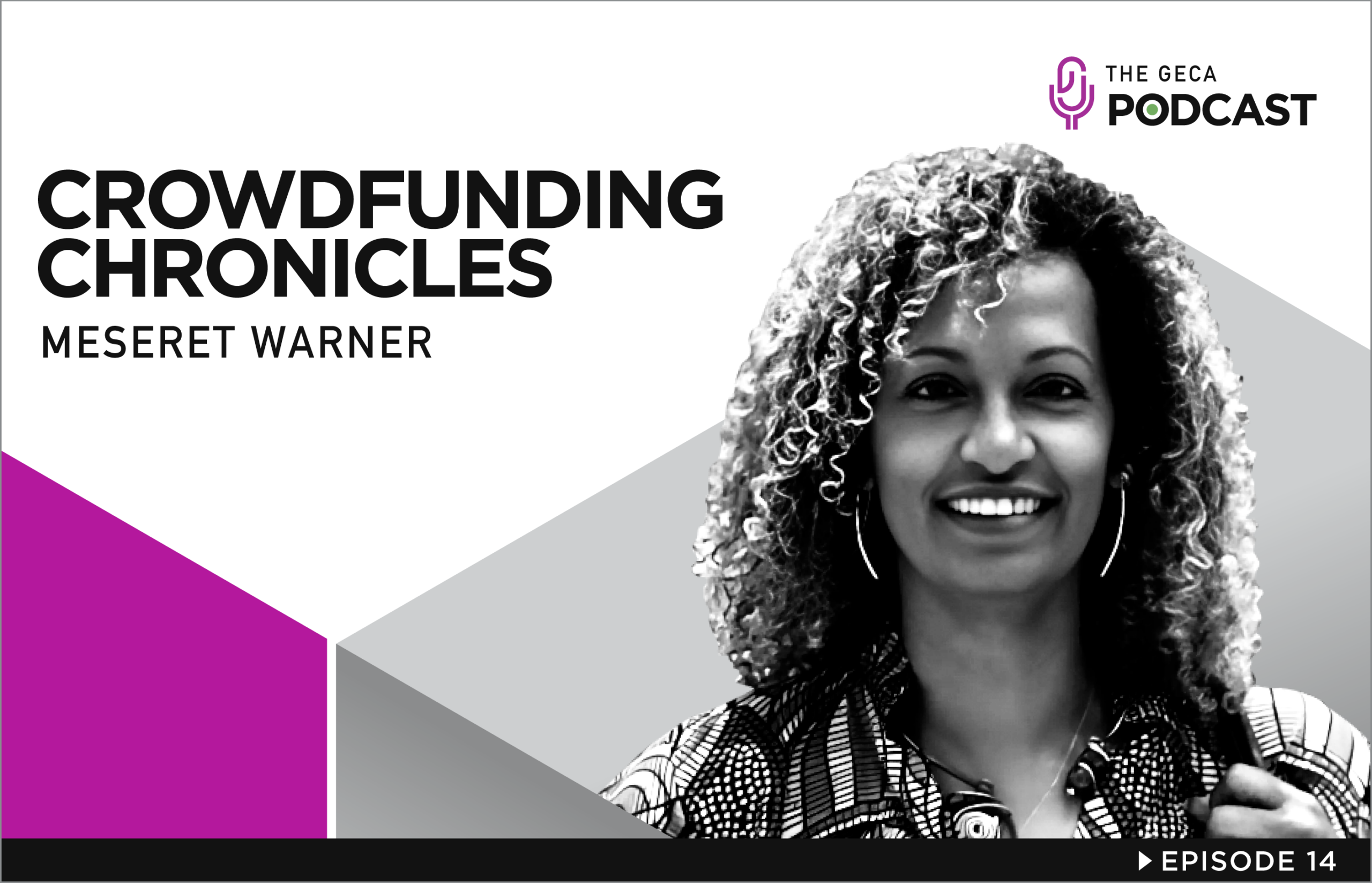
Diaspora Capital & Ethiopian Crowdfunding: Meseret Warner's Vision | GECA Podcast
Most diaspora send money home as gifts. What if those billions became investments instead?
Over $100 billion flows into Africa annually as remittances – consumed, gifted, never invested. Meanwhile, 95% of Ethiopian businesses can’t access traditional finance due to lack of collateral. What if redirecting even a fraction of diaspora capital could change entire economies?
Join Andy Field in conversation with Meseret Warner, founder of Ignite Investment (Ethiopia’s first equity crowdfunding platform) and GECA Steering Committee member, as she reveals how to bridge the gap between diaspora capital and African entrepreneurship. From IT developer in Canada to pioneering fintech in Ethiopia, Meseret shares the trust-building journey required to convert remittance senders into equity investors.
From proving the concept through digital marketing alone (raising millions before building a platform) to navigating Ethiopia’s regulatory sandbox, Meseret breaks down why trust matters more than technology, how to make companies “crowdfund ready,” and why women entrepreneurs actually repay debt at higher rates than men.
Key insights:
- Why diaspora communities are emotionally invested – not just financially
- How to convert one-way remittance flows into two-way equity investments
- The critical role of regulatory sandboxes in emerging markets
- Why 65% of Ignite’s funded companies are women-led enterprises
- How partnerships with GIZ and African Development Bank enable scaling
- The coordination gap: why retail investors face barriers high net worth individuals don’t
- What incremental progress in the UK, US, and Ethiopia signals for global crowdfunding
Remittances fund consumption. Investment builds economies.
ALSO AVAILABLE ON


Share this article


Andy Field (Host): Hello everyone, and welcome back to the GECA Podcast — the voice of global equity crowdfunding. I’m Andy Field, Steering Committee Lead of the Global Equity Crowdfunding Alliance, where we speak with the leading voices shaping the future of capital raising across borders.
As crowdfunding continues to evolve, we’re exploring what it takes to run successful campaigns on a global basis — and what founders, platforms, and investors need to know to thrive in this ever-expanding ecosystem.
Today’s episode is a particularly special one because I’m joined by someone whose work genuinely challenges how we think about capital, borders, and opportunity.
I’m delighted to be speaking with Meseret Warner, Founder and Managing Director of Ignite Investment — Ethiopia’s first equity crowdfunding platform — and also a recent addition to the GECA Steering Committee.
Meseret brings a truly global perspective to this conversation. Over the course of her career, she’s worked across international institutions, including the United Nations and national statistical agencies, before going on to become one of Africa’s most influential fintech pioneers.
What really sets her work apart is her focus on diaspora capital — and her belief that the billions of dollars sent home every year as remittances can, and should, be transformed into productive long-term investment.
Through Ignite Investment, Meseret has helped design a borderless equity crowdfunding model — carefully navigating U.S. regulatory requirements and Ethiopian laws — facilitating millions in investment and supporting a remarkable number of women-led enterprises, all while building that all-important trust infrastructure and regulatory alignment in a complex, evolving market.
The evolving Ethiopian capital market and the growth of regulatory sandboxes have opened doors for financial innovations like Ignite.
At GECA, we talk a lot about breaking down borders in equity crowdfunding — and Meseret’s work shows what that looks like in practice. Not as a theoretical ideal, but as something that can materially change lives, businesses, and economies.
In this conversation, we’re going to explore Meseret’s journey, the power of diaspora-led investment, the realities of building crowdfunding in emerging markets, and what her experience can teach us about the future of truly global equity crowdfunding.
So, welcome Meseret. It’s great to have you here.
Meseret Warner (Guest): Great to be here. Thank you, Andy.
Andy Field (Host): And for those who may not know you yet — and I can’t believe there are many, because I’ve seen you in lots of webinars recently, right across the globe — how do you usually describe what you do, in plain, simple terms?
Meseret Warner (Guest): Yeah — I guess, in very simple terms, I always work on expanding access to finance for those who have traditionally been excluded. Whether it’s borrowing money to run businesses or for personal needs — having good access to finance really does open opportunities.
So my work has always been that. It could be crowdfunding, it could be something else — but at the end of the day, that’s the core of what I do.
Andy Field (Host): Yeah. And I mentioned very briefly in my introduction that your career path is vast — there’s a lot in there.
From working with the UN and national statistical agencies to founding Ethiopia’s first equity crowdfunding platform — what was the moment where you said, “This is what I need to build. This is what’s needed”?
Meseret Warner (Guest): You know what it’s like — like anything else, it wasn’t really like I woke up one day and said, “Oh great, this is what I’m going to do.” I wish it was that easy.
Andy Field (Host): It would be easier.
Meseret Warner (Guest): Exactly — then you’d know what you were getting into right up front.
No — it’s really a path. It’s a process.
I’m diaspora myself. I came back from Canada — that’s where I lived most of my life. I was doing other things, but then I got involved in a project in Ethiopia, and they asked me to help them raise funds.
And I immediately started thinking: where is capital? Where can we access finance? Especially in Ethiopia, where companies can only borrow money if they have an immovable asset — collateralised debt financing — and 95% of businesses are small businesses and startups, where they don’t have collateral and they can’t borrow.
So working on those projects, I could see everyone was struggling to access finance.
And then on the other side, you see billions coming in. That was easy for me to see because I’m diaspora. I used to send money to my mum and my family when I was there — when someone says they need money for something, you send it.
So I started putting those pieces together.
At the beginning, I was thinking we need diversified sources of finance — angel investors, venture capital, private equity.
But I quickly learned it’s not that easy. There are many factors. Those markets aren’t mature in Ethiopia, and you don’t see those flows very easily.
So I thought: okay — here is capital that is flowing very easily: remittances. It’s mostly consumption. There’s even a high cost to send money as remittances. But it’s a clear flow.
So I started looking at the problem and saying: here is a huge need, and here is a huge pool of capital — how do you bridge those two?
Before the platform, we tried to prove the concept. Even in a well-known project where the promoters were trusted, it was easier to mobilise capital — even without a platform. I was doing digital marketing and other things — things I knew from my career. I was an IT person; I was a developer in Canada for years.
And I was surprised to see we were able to raise millions from diaspora all over the world — completely off-platform.
That proved something important: if you give people access to structured, trustworthy, and transparent opportunities, there is openness to invest.
That was the evolution — and that’s how I got here.
Andy Field (Host): That answers what was going to be my next question — how your personal journey has shaped your thinking.
So, what changes when diaspora communities move from sending money to actually owning part of businesses they believe in?
[00:09:00]
Meseret Warner (Guest): It’s definitely a process.
When diaspora are sending money — like I said, I used to send money to my family — it’s easy. One, you send it to someone you know. You hope you know what they’re going to use it for.
Andy Field (Host): What they’ve told you they’re going to use it for.
Meseret Warner (Guest): Exactly. Sometimes you find out later it was used for something else — but from the sender’s perspective, you’re sending it to family. You’re not expecting anything back. It’s gone. It’s a donation, a gift — consumption. It’s a one-way street.
There’s no due diligence. Nothing.
But when you introduce the idea: “Instead of sending money repeatedly, what if you invest so the person or business becomes self-sustaining?” — that changes everything.
It’s the old saying: don’t give someone fish every day — teach them how to fish. That changes economies. It may not be your exact family — but it can help your country and your community.
And because I came back and I’m on the ground, I can see the Ethiopian diaspora are actually among the biggest investors. People like me gave up jobs, came back, put in money, built businesses.
So it’s not foreign to them — they do invest. But equity crowdfunding adds structure and accessibility.
The first thing I learned is: trust, trust, trust.
If I give it to my mum, I know it gets to her. But if I invest through a platform: how do I know you invested it properly? How do I know the company won’t take the money and disappear? How do I see the impact I’m looking for?
So having that conversation takes time. It’s worth it — and each time we have it, more people convert than I expect. But you need patience.
And also — equity crowdfunding isn’t just the fancy technology. In Ethiopia, it’s about building the entire ecosystem.
The companies raising funds often aren’t “platform-ready.” They aren’t prepared to share diligence materials the way someone in Washington DC would expect.
So we had to work on both sides: educate and build trust with investors — and support fundraisers to become investment-ready.
That’s partly why we partnered with GIZ (a German development agency implementing partner). They focus on private sector development. We said: these companies want to raise funds, but they need support to become investable — to become “crowdfunding-ready.”
In the U.S., you can hire marketing agencies — but it’s expensive. People talk about spending up to $50,000 USD to be ready to raise. But if an African company is raising half a million, they can’t put $50,000 — close to 10% — into preparation.
Andy Field (Host): That’s interesting — because the “crowdfunding-ready” challenge is global: marketing, getting a crowd behind you, preparing to list — and trust is absolutely universal.
So what surprised you most once Ignite Investment went live?
[00:16:00]
Meseret Warner (Guest): I was pleasantly surprised. A lot of people were already looking for something like this.
The diaspora are emotionally invested. They’re passionate about seeing progress. It’s not like investing in Apple stock — that’s purely numbers. With diaspora, there’s also identity and impact.
So as soon as they saw a pathway to invest, it was surprising. In the first week we launched in 2022, we had about 30 sign-ups — and half were investors — from five different countries, mostly the U.S. and the UK, asking: “How can I invest?”
They didn’t know me, they didn’t know Ignite — but they read, they reached out, they signed up. It proved we were filling a gap.
Andy Field (Host): And a lot of the enterprises you’ve supported are women-led. Was that intentional?
[00:18:00]
Meseret Warner (Guest): Yes — very intentional.
I’ve been working on women’s economic empowerment for years. I was President of the African Women Entrepreneurs Program — we had 42 chapters across Africa.
When you look at access to finance, it’s already difficult for SMEs — but for women, it’s even worse. Only a tiny fraction of funding goes to women-led ventures.
Even me — I’m well-spoken, I’ve worked globally — and I still don’t have access in the same way many of my male peers do. That’s just how the world works, and it’s even harder in Ethiopia.
I’m also a numbers person — computer science and mathematics — and when I look at the data, it’s shocking.
So we deliberately reach out to women-led ventures, because they’re less likely to reach out the same way others do, due to social norms, networks, and other disadvantages.
And you’d be surprised — many have amazing ventures. And they often repay debt at better rates than men-led ventures.
Andy Field (Host): I wouldn’t be surprised at all.
Let’s talk about regulation. Ignite operates within Ethiopia’s regulatory realities. What has that experience taught you about working constructively with regulators?
[00:21:00]
Meseret Warner (Guest): It’s essential. Especially where there isn’t a clear crowdfunding framework.
Most African countries don’t have dedicated crowdfunding regulations. Some platforms operate through existing financial regulations — but crowdfunding is different. It needs its own framework.
So you must bring regulators with you.
In Ethiopia, the Capital Market Proclamation came out in 2021 — and I was engaged from day one. When the regulatory sandbox opened for innovative financial systems, we applied like anyone else, and we’re still working with them.
We also worked hard to stay compliant by design. We registered the company in the U.S. and comply with U.S. regulatory requirements, and we also operate within the open rules available in Ethiopia — for example, foreign indirect investment pathways.
If you’re not compliant, you can be shut down overnight — and cross-border investment is already complex. Without regulatory support, it becomes impractical and unscalable.
We genuinely believe in the opportunity. Over $100 billion comes into Africa as remittances each year — and diaspora already invest, just not always through structured channels.
That’s why partnerships matter — like GIZ, and we’re also partnering with the African Development Bank. If we prove the concept and scale it, we can expand into other African countries.
And there’s progress: the Ethiopian approach is increasingly to say, “Tell us what you’re doing — and let’s see how it can become a regulated solution,” rather than simply saying no.
That openness matters — and you get there by engaging them consistently.
Andy Field (Host): That makes sense. And I imagine that’s part of why GECA resonated with you, and why you joined the Steering Committee — access to people and insights across the globe that can help the work in Ethiopia.
[00:26:00]
Meseret Warner (Guest): Absolutely. When I heard about GECA, I thought: “It’s about time.”
We need standards.
High-net-worth individuals and accredited investors can invest anywhere — Dubai, China, South America, the U.S. — no one stops them. But for crowdfunding, regulations are so restrictive and fragmented.
So if you’re a retail investor and you want to invest $100 into your home country legally and transparently, it becomes extremely difficult.
That’s why coordination matters. Even a little harmonisation would make a huge difference — like how global systems such as SWIFT enable coordination.
We’re not asking for identical regulation everywhere — but some baseline alignment could unlock opportunity and democratise access to investment.
That’s what crowdfunding was meant to do: give startups and SMEs access to capital when they can’t access venture capital — and allow communities to back them.
Andy Field (Host): Exactly. So what gives you the most optimism right now about the future of global crowdfunding?
[00:30:00]
Meseret Warner (Guest): We’re making progress — real progress.
Look at the UK: crowdfunding has raised billions. Those success stories open doors and push policymakers to catch up.
And it’s been incremental — but meaningful. In the U.S., under the JOBS Act, it started with under $1 million and low individual limits. Now it’s up to $5 million. Those improvements happen because impact is visible.
SMEs and startups create the majority of jobs — over 60% in most economies. If you give them access to finance, they lift the economy and everyone benefits.
So yes: incremental progress gives me hope.
Andy Field (Host): I couldn’t agree more. Meseret, this has been fascinating. Before we finish — where can people follow you and learn more about Ignite Investment?
[00:32:00]
Meseret Warner (Guest): Absolutely. Our platform is igniteinvestment.com. People can visit and see companies raising, and we have a video showing how it works.
I’m also very active on LinkedIn — that’s the best place to find me and follow our work. We have an office in Ethiopia, and a registered company in the U.S.
And of course, through GECA as well.
Andy Field (Host): Brilliant. Thank you.
Meseret, thanks so much for sharing your story and insights today. Your work is a huge reminder that equity crowdfunding isn’t just about technology or regulation — it’s about unlocking opportunity, building ownership, and creating pathways for capital to flow more efficiently to the people and ideas that need it most.
Conversations like this are exactly why GECA exists: to bring together diverse global perspectives, challenge fragmented thinking, and help shape a more connected and inclusive equity crowdfunding ecosystem.
Thank you, Meseret — and we’ll speak again soon.
And to our listeners: thanks for tuning in. Stay with us for future episodes as we continue to explore the people, the policies, and the platforms unlocking crowdfunding without borders.
Don’t forget to follow GECA for more conversations with the people shaping the future of global equity crowdfunding.
And visit thegeca.org to learn more about our mission, our growing global supporter base, and how you can get involved.
Thanks, Meseret — and thanks everyone for listening. We’ll see you next time.
[End of Transcript]