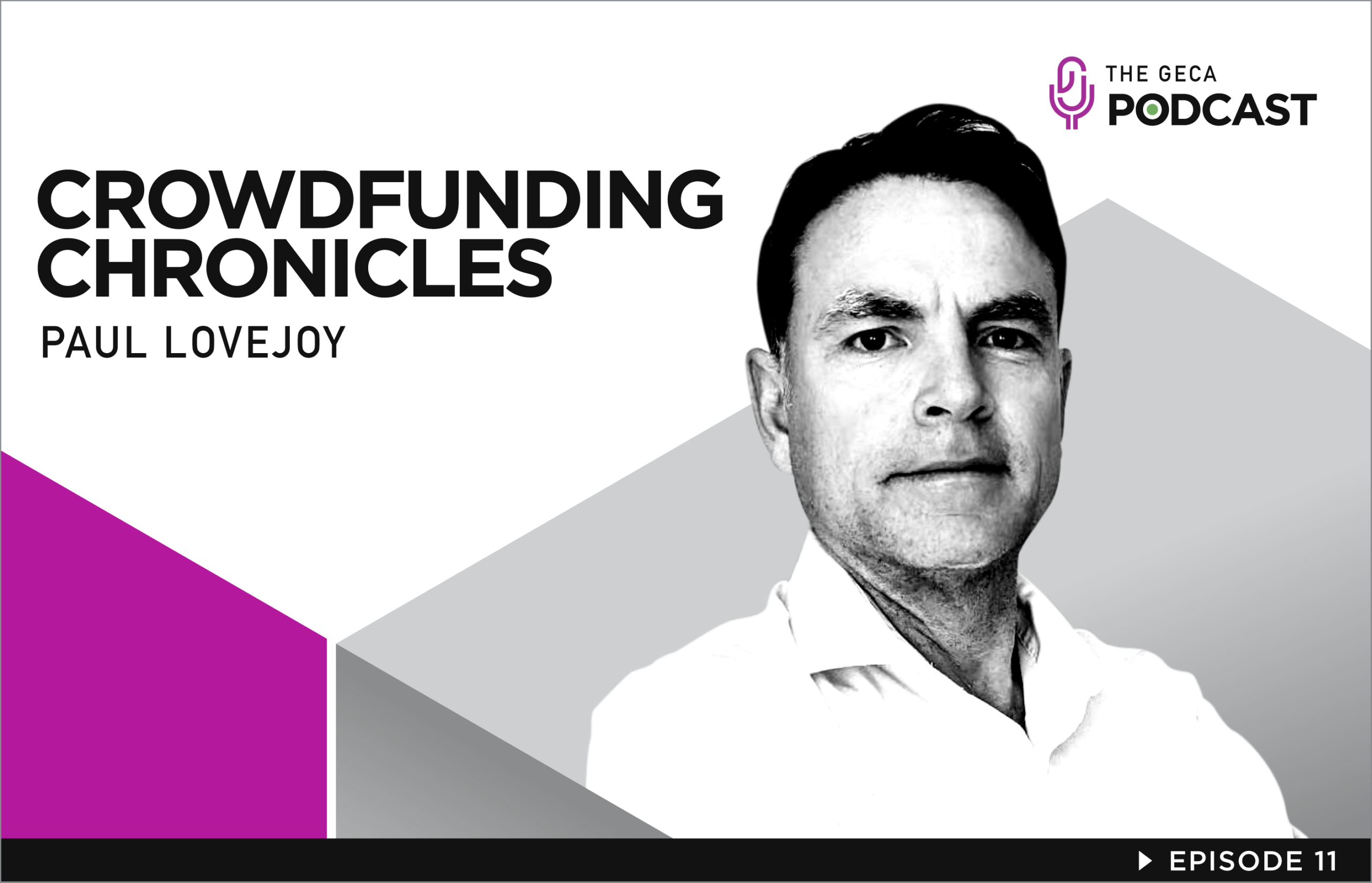
From Defrauded Investor to Crowdfunding Champion: Paul Lovejoy's 366 Days | GECA Podcast
Join Andy Field for an inspiring conversation with Paul Lovejoy, Principal Investment Advisor at Stakeholder Enterprise and 2024 recipient of the Crowdfunding Professional Association’s prestigious ‘Pay It Forward’ Award. From experiencing devastating financial fraud in 2008 that affected his entire family, to discovering crowdfunding’s transformative potential during COVID, Paul shares his remarkable journey of recovery, learning, and advocacy that led him to become one of the industry’s most prolific retail investors.
In this episode, Paul reveals the insights gained from his unprecedented 366-day daily investment streak – a commitment that saw him invest in over 400 small businesses, family farms, clean energy projects, and community development initiatives, achieving a 33% cash flow return in just 20 months while starting with investments as small as $10. He breaks down his strategic portfolio allocation of 50% debt, 30% equity, and 20% real estate across 432 real estate developer loans, 70+ small businesses, and 20+ family farms, demonstrating how extreme diversification creates built-in risk mitigation that traditional public markets cannot match.
Beyond the numbers, Paul discusses the philosophical framework that drives his work – the concept of “paying it forward” through accepting responsibility for systemic problems you didn’t create because it’s in your enlightened self-interest. Drawing from his competitive water polo background, he explains how proactive thinking and designing systems that eliminate fraud (rather than just policing it) can reshape the entire crowdfunding ecosystem. He offers candid insights into the challenges facing the industry, including why SAFEs (Simple Agreement for Future Equity) borrowed from Y Combinator’s incubator model don’t serve crowdfunding communities well, and why we need investment instruments specifically designed for platform-mediated retail investment.
Paul shares practical advice for new investors – start small with $10-25 in debt instruments, use AI and Yelp for accessible due diligence, and treat every investment seriously regardless of size – and offers crucial guidance for founders on building community before launching campaigns. He discusses how technology is democratizing due diligence, why exit strategies beyond IPOs and mergers (like dividends and stock buybacks) deserve more attention, and how crowdfunding platforms are literally building the infrastructure for an alternative financial system where regular people, not concentrated wealth, determine what gets funded.
Whether you’re interested in impact investing that delivers both financial returns and community transformation, learning how to build a diversified portfolio outside traditional public markets, or understanding how crowdfunding can address inequality while serving your own long-term interests, Paul offers invaluable perspectives from someone who has put his money where his mouth is – 366 days in a row. His commitment to education, transparency, and systemic change exemplifies GECA’s mission of creating a borderless crowdfunding ecosystem that democratizes access to capital and investment opportunities worldwide.
ALSO AVAILABLE ON


Share this article


GECA Podcast Transcript: Paul Lovejoy Interview
[Intro – GECA Announcer]: Welcome to the GECA Podcast, powered by the Global Equity Crowdfunding Alliance. Dive into the realm of borderless equity crowdfunding, where we bring the world’s top experts and industry leaders directly to you, discussing innovations that are redrawing the boundaries of finance. Ready to expand your horizons? Here’s your host, Andy Field.
Andy Field: Hello everyone. Welcome back to the GECA Podcast, the voice of Global Equity Crowdfunding. I’m Andy Field, Steering Committee lead of the Global Equity Crowdfunding Alliance, where we speak with the leading voices who shape the future of capital raising across borders. As crowdfunding continues to evolve, we’re exploring what it takes to run successful campaigns globally, what founders, platforms, and investors need to know to thrive in this ever-expanding ecosystem.
And today I’m really thrilled to be joined by Paul Lovejoy. Paul is Principal Investment Advisor at Stakeholder Enterprise. He’s based in Hawaii—lucky for some. He’s a longtime advocate for crowdfunding, a prolific investor himself, and he’s also this year’s recipient of the Crowdfunding Professional Association’s ‘Pay It Forward’ Award, recognizing his incredible contribution to the crowdfunding community.
Paul, congratulations again on that award and thanks so much for joining us.
Paul Lovejoy: Oh, I’m thrilled to be here. I love the fact that you’re trying to eliminate borders for crowdfunding. I think that’s such a wonderful mission and I’m thrilled to be a part of it.
Andy Field: Oh, thank you. Thanks again for joining us. For listeners who may not know your story, can you just give us a very quick overview—just a couple of minutes—of how you first got involved in crowdfunding and what’s made you so passionate about it?
Paul Lovejoy: Yeah, back in 2008, I was a defrauded investor, financially devastated by the system collapse. And it caused me to spiral down into this shame and sleepless nights. I was in denial about it. And it was awful, really, because it wasn’t just my money I lost—it was also my family’s money. It was a horrible event and it took years for me to recover from just the trauma and get over the shame part of it. I didn’t publicly admit that for 10 years.
Anyways, I did finally get myself together and I forgave myself. I let go of the past and it allowed me to ask the question: what the heck just happened? What is going on? So it led me in a direction where I went from real estate to wealth management.
And when I got into wealth management, I saw that there was all this gatekeeping happening with the private market. In the United States you have to be something called an accredited investor and meet certain wealth thresholds. And so I saw that entire populations—large populations, something like 90% of the US—couldn’t invest in these private markets. Just this whole financial gatekeeping. Working in wealth management, I really lost my motivation to work there.
One thing I did see while I was there was peer-to-peer lending and I was like, “That’s interesting. It’s not the public market. It’s not a private market. What is this?” But I didn’t really think about it too much longer. I ended up losing my motivation to work in wealth management because of this financial gatekeeping and telling people, “You can’t have services with us.” I hated telling people that.
And that’s right when COVID hit. And another thing I got interested in was something called impact investing. And I was wondering what’s the difference between ESG and impact investing? And what I saw with all my research is that the only way you can make an impact investment was in the private market. And the only way you can be in the private market is if you were an accredited investor.
But then I remembered—I was like, what about that peer-to-peer lending stuff? And so I did this Google search: “retail access to private markets.” And that’s when crowdfunding popped up, regulation crowdfunding. And I was like, “Oh my gosh!” It was like all the dots connected for me. I was like, “Oh, this is how people can actually fund businesses they care about.”
And it allowed regular people access to really great investment opportunities that were reserved for the wealthy. So it had multiple layers: a financial layer where regular people can prosper on some really great investment opportunities, and the fact where you can fund a business that you care about in your community and that delivers real impact, shaping the future. So that’s how I got into crowdfunding. I opened up my own firm. I was just all in when I saw it.
Andy Field: Yeah, I can see how that struck a chord. Actually, you and I met for the first time—we’d obviously connected on social media previously—but a couple of weeks ago, I was over in Washington DC, as were you, at the CfPA Summit. And you were telling me some of these stories then, and I find it fascinating how that resonated with you at that time and you went straight away all in. That shows a real act of faith if you like. And you’ve built a really strong reputation in this space now.
And I know one of the things that we were talking about over in DC, and one of the things that really stands out, is your daily investment streak. So can you tell us a bit about how that started and what inspired you to commit to essentially investing every single day for—and you’ll tell me how long that was?
Paul Lovejoy: Yeah, it was for 366 days in a row because I wanted to do it for a year straight and the year I happened to choose was a leap year.
Andy Field: Yeah, great!
Paul Lovejoy: So why not one extra day? So really what I was seeing is that there were tremendous financial opportunities within this space. And I didn’t like what I was seeing in our public markets anymore, here in the US—and I know it’s similar around the world—where you have institutional investors that manage retirement accounts and they basically control the entire public markets. And it’s just three of them. And they’re using algorithmic trading to optimize to get the best stocks.
And now here in the US, it’s basically called the Magnificent Seven. So you have all this concentration of wealth, and it’s trying to optimize to get the best bang for their buck to optimize shareholder value. And seven stocks do that. So we don’t have a very diversified, in my opinion, a very diversified or safe public market.
And what I saw in crowdfunding, I saw opportunities that were highly diversified. And so I wanted to show that you can have a legitimate financial plan without using our public stock markets. So that’s what motivated me to do this. And then at the same time, I was like, if I’m gonna be recommending or advising or creating financial plans for this, I need to put my money where my mouth is. I need to really understand what people go through when they make these investment decisions.
And so I got a really unique perspective as a customer, as an investor, and as an advisor too, to really go deep into this type of financial market. And it was an incredible experience. So that’s what motivated me. That’s why I did it.
Andy Field: And was it 366 different investments that you invested in?
Paul Lovejoy: Almost. So there were a couple of times that I invested in a fund, so there’s Fundrise—
Andy Field: Yeah.
Paul Lovejoy: —and they have this venture fund, the Innovation Fund, where it’s venture capital and it’s pretty neat because average people can invest in OpenAI, ChatGPT, Canva. They have some really great digital infrastructure businesses that regular people can’t invest in. And it was $10 minimum.
I guess I did have some cheat days, you could say, where I went back into a fund. And there was about four or five of those funds where I went back to them on a regular basis. So otherwise it would be a little crazy if I didn’t do some of that stuff because—
Andy Field: Absolutely, yeah.
Paul Lovejoy: —especially when I went on vacation. My wife hated me. I did an investment every day still on vacation. She hated that. But having some of those funds to invest, that did help, like on travel when I’m flying. So it worked out.
Andy Field: Yeah, and it’s interesting you mentioned the $10. I bet there’s a lot of people out there who don’t realize that you can invest such a small amount.
Paul Lovejoy: Yeah. And there’s not just one platform where you can do that. There’s many different platforms. You can invest in clean energy and climate tech, and small businesses with $10, community development, short-term real estate loans. And the diversification I had throughout the year is just insane.
So some of these short-term real estate loans, I can do a $10 minimum and they would split that $10 into a dollar into different loans. So after the end, I had over 430—I think it was 432 exactly—small real estate developer loans. So I invested in over 400 of these small little real estate projects. And the diversification of that, you can’t beat that in our public markets.
And then on top of that, the small businesses I had—something like 70 different small businesses that I invested in over the year. Then there was the climate projects and the farms I invested in—close to 20 different family farms throughout the year. So it was just really amazing.
One thing that I really discovered about myself was when I went into that, I was like, “Yeah, I’m a good investor. I know what I’m doing.” By six months in, I looked back and I was like, “I wasn’t as good as I thought I was.” It’s like when you do something every day, there are things that you just see that you didn’t before. It’s practice. Obviously anytime you practice something, you’re gonna get a lot better at it.
And at the end, I felt really humbled. Now I don’t think I’m some great investor. I know that there’s a lot more to learn out there, but I am so much better than I was before I started that. So it’s been very rewarding, having that experience.
Andy Field: So learning so much from that year streak, has that changed how you think about risk, opportunity, and impact?
Paul Lovejoy: It changed a lot. For one, it confirmed what I thought: that when you diversify across hundreds of business opportunities, that’s a built-in risk mitigation strategy. Because, like the real estate stuff, that’s all backed by actual real estate. So out of the 400-something loans, something like three of them did default, but I didn’t lose any money because we were able to take control of the house. So the risk mitigation factor is fantastic.
Another thing that was going on was some of the wild stock market volatility going up and down. I wasn’t concerned about any volatility. A lot of my investments were in loans, not equity—these were more debt-based. In fact, I did an allocation of 50% debt, 30% equity, and 20% real estate.
And I gotta tell you, after 20 months since I first started, I’ve already had a 33% cash flow return. So I invested a total of $12,000 throughout the year. A third of that, about $4,000, has already been returned to me, and I’ve reinvested that amount already.
So it shows that you can have a great investment strategy, super diversified, mitigating all kinds of risk, and it’s compounding your interest. And so now I’m buying, supporting more small businesses and I’m prospering for it too. It’s this awesome situation where I’m helping this family farm build a micro solar grid on it, and I’m getting a 10% return. To me, it’s really hard to beat. And it’s diversified across so many levels that to me it’s obvious that this is a much safer approach than what all other financial planning is doing.
And on top of that, if you wanted to research a lot of these small businesses, one thing I discovered was Yelp is a fantastic place to do due diligence. They have all kinds of reviews and all these small businesses—you can see right away if, “Oh, they just put up their Yelp page. Huh. Suspicious.” Or if you see that they had this Yelp page for five years and five-star reviews, there’s a lot that you could see as just a regular person very easily. It doesn’t take a lot of work either.
And also with AI coming into play, it can read these large documents very easily. It takes a lot of effort doing due diligence every day. But if you can copy text and put it into an AI and have them read it for you, that is a huge help because that’s really what they’re best at. AI is reading through documents, not making stuff up. There’s no opportunity to make stuff up. It’s either in the document or it’s not. That was a big help for me also.
Andy Field: Yeah, those technological advancements. Again, when we were talking in DC we were talking about how much they’ve helped the due diligence process. And I guess that whole project is almost the catalyst for something wider. You mentioned that the money’s being reinvested now. The snowball effect is obviously starting to happen, so it’s a really interesting way of kicking off what will be a very long-term project I assume.
So let’s move on a little bit. I just want to talk about the award that you won recently, the ‘Pay It Forward’ Award from CfPA. It’s such a meaningful recognition. I just want your perspective on what paying it forward means to you personally. How do you try to embody that in your work within the crowdfunding community?
Paul Lovejoy: I am a lifelong water polo player. I actually played water polo very competitively up into my thirties. But when I was in high school, first starting, I remember we got destroyed by this team. And they had just an incredible counter attack and we just got crushed.
And I remember my coach saying, “While you guys were being reactive, they were being proactive.” And then he went on to say, “They’re not thinking, ‘Oh, we need to stop them from scoring a goal.’ They’re thinking, ‘When we get the ball from them, I’m gonna be swimming down, beating my guy to score.'” So they already had it in their head that this is what they were gonna do. It’s like when you act on something and you know the reason why you’re acting, you have that next step, it motivates you even further.
So essentially, it’s about being proactive. Paying it forward, it’s about literally being the change you wish to see. You’re not paying something back. You’re not reacting to something. You’re looking at the world and saying, “How do you make it better?” And it’s by paying it forward.
And to me, to pay it forward, I think you have to accept responsibility for problems you didn’t create. And that’s the only way I think that would motivate you to pay it forward. Now, some people may be like, “Why would you ever accept responsibility for a problem you didn’t create?” And the answer to that is: it’s because it’s in my own self-interest.
When inequality deepens, social cohesion collapses. People turn on each other instead of questioning the systems exploiting them. Furthermore, when people are stripped of opportunity and dignity, that’s when crime and violence rise. Meanwhile, if we feel entitled, we’re gonna hide behind guns and gates, fearful of a system that we help perpetuate.
Yes, it is in your self-interest, but you almost have to think of it as an enlightened self-interest that it benefits me to have an economy that looks out for the wellbeing of others and our planet. So that’s what paying it forward to me means. It really is a very meaningful award that I got because it’s something that I care about deeply. And I was surprised—I didn’t even know it really existed. And to get that recognition, it meant a lot to me.
Andy Field: Very well deserved as well. And that’s a really good way of framing it. It’s almost—I think what you’re saying is that this is, look, it’s not purely altruistic here. There is some benefit for me to help solve the problems even if I didn’t cause them. Which is a great way of thinking. And I think most people will get their head around that. So that’s a really interesting way of putting it.
So what are some of the ways that you try to—you’ve mentioned that it’s not giving back as much, but I’m sure you do give back to the industry. Whether that’s mentoring or, obviously, from an advising perspective, you help founders and new investors get started. What does that look like for you on a professional level?
Paul Lovejoy: There was one company that I really embraced during my daily investment. I invested in this one company on three different raises. They paid me back on one of the raises, and they’re still paying me back on two of the others. So anyways, I was like, “Wow, this is great.”
There was a hurricane that hit during that year, and I saw this company drop everything what they were doing, and they went to this small town that was up in the mountains in North Carolina that got devastated by the hurricane. They came in with their chainsaws, cleared the road, and then they set up a solar microgrid in the community. And it provided power to the general store that they had up there where people would put their food in the refrigerator, charge their phones. It literally was a lifeline for this community for 47 days that they had this thing up there. And I was blown away. That was like real impact.
I’m seeing my small investments go to this company and now they’re literally sending a lifeline to these people devastated by this disaster. And so they wanted to have a larger raise on Wefunder. And I was very advocate—I loved what they were doing, and I was showcasing on social media. I was engaging with them and just loving what they’re doing. They asked me to be lead investor on their Wefunder campaign.
Andy Field: Oh, okay.
Paul Lovejoy: And I absolutely agreed to do that. And it was Ovanova—I think they’re around. The raise has closed, but wonderful company. I didn’t benefit financially. They didn’t pay me to do it. In fact, I invested in them. So if they’re—to me, if I feel aligned with a company, then I’m not looking necessarily to make money off of them unless it’s some mutual benefit. I’m happy to give what I’ve learned about successful raises, what you do, and not only that, what type of investment vehicle that you choose to raise funds with. Is it gonna be a SAFE or is it gonna be a revenue sharing note, or whatever have you. And I do have some opinions on that as well.
Andy Field: Okay. That’s really interesting. So over the time that you’ve been involved in crowdfunding, from your perspective right now, what are the biggest—I guess looking at it from two fronts—what are the biggest opportunities that the industry has to potentially take advantage of? And what are the biggest challenges that also, as an industry, we face as the industry is maturing and evolving?
Paul Lovejoy: Well, a lot of the opportunities and challenges are mixed together, they’re intertwined. One thing is, I think a big challenge is the SAFE. It’s a very outdated financial instrument. You have something like that in the UK, a SAFE?
Andy Field: No, I was just gonna say, could you just explain a little bit just for people outside of—
Paul Lovejoy: It stands for a Simple Agreement for Future Equity. So you don’t really know exactly what you’re valuing your company at. You just want to get some money raised and then you get a valuation later. The people who invented the SAFE was Y Combinator. It’s an incubator in the Bay Area, Silicon Valley. And it was perfect for their ecosystem because they’re the ones doing the valuation in the next round. So it made a ton of sense: “Yeah, we’ll worry about that later.”
And the SAFE protects the founders and it doesn’t really protect investors all that much, but it didn’t matter to Y Combinator because they’re the ones that were gonna set the terms the next round. But nobody knew what they were doing in our industry. “What are we gonna use? Let’s use Y Combinator’s SAFE.” No one thought, “Hey, what works best for a crowdfunding industry?” Instead, nobody wanted to take any risks and just, “Let’s just use what’s already been out there.” And that’s what happened with the SAFE. And we’re stuck with it because network effects have taken place, and that’s all anybody uses right now.
And so trying to switch something off that—that’s an incredible challenge. So I think that’s one of the things like we need to come up with investment vehicles specifically designed for investment crowdfunding, not designed for an incubator. And so I think that’s a real challenge.
I also think that equity in general is a bit overused in the sense that when founders are saying, “Okay, I’m doing this equity raise,” they don’t really know the exit strategy. And most people think, “Oh, it’s IPO or a merger.” There are other exit strategies that you could think of that are probably more beneficial for investors. An exit could be a dividend. An exit could also be a stock buyback. A company could buy back stock. There doesn’t need to be this pressure of this huge 50x exit or even a 20x merger. That pressure oftentimes will make the company fail.
If you don’t put that pressure on and say, “Hey, a healthy exit is dividends,” okay, that’s great. And as a financial planner, I would prefer that because that is something that’s far more predictable than trying to use power law. Although there are companies where this traditional kind of IPO merger makes a ton of sense, especially in pharma. You have a lot of these bio medications that are made or these technologies, and that’s a perfect step up for a larger pharmaceutical company to acquire that technology. So I get that. But some of these other businesses, it just makes no sense to do that.
And I think the opportunity is incredible for our entire industry. The way I see it is that the people who are involved, we are literally creating a brand new infrastructure for an alternative financial system. It’s not one where large institutions or concentrations of wealth determine what gets built, what gets funded. It’s people. And so we get to build that infrastructure where no one is too big to fail, essentially.
And I think it’s such a rewarding thing to be a part of, to have, to be able to put input in on how this brand new alternative financial system is being created. And I just wouldn’t wanna be in any other space. It’s such a huge opportunity. Generational. It’s an amazing opportunity that we all have in this industry.
Andy Field: Yeah.
Paul Lovejoy: And I think it’s awesome what you’re doing. You’re taking that opportunity to say, “Hey, world, let’s come together and we can figure out how to have an incredible infrastructure.” So I just love being on this podcast. I love what you’re doing, Andy.
Andy Field: Yeah, thanks Paul. No, I appreciate that. And actually, when you were talking there about the challenges and the opportunities, it comes back down to something that keeps coming up in the roundtables that we hold and the podcasts that we do. And everyone we’re talking to really emphasizes the importance of education. Talking to founders and educating them about the importance of—first of all, realizing and understanding what their exit strategy is going to be, what that exit strategy is going to be, then being able to communicate that.
Down to educating and helping policymakers and regulators to help make some of the things and bring some of the things to life that we are striving to achieve, which is obviously to create a borderless ecosystem. So that if you are interested in a certain line of business in the United States, you can look for that certain line of business opportunities outside of the United States, in Sweden, in Finland, in Asia, and not have to worry about the fact that they’re in a different jurisdiction. You could still invest relatively easily.
I know it’s possible to invest across borders, but it’s very difficult. And we just wanna make that so much easier and so much more transparent. So that’s fantastic. So I suppose what I was gonna say there was, it kinda leads on nicely. Do you think we’re getting any closer to that true cross-border or global crowdfunding? And what do you think needs to happen for that to start to become a reality?
Paul Lovejoy: Interestingly enough, I met some people in DC a couple weeks back from Mexico, and they wanted to use tokens for cross-border. And that potentially could be a mechanism that could be used—using these new digital tokens to find a way around it.
Now, personally, I think what needs to happen is we need to design systems in place that makes it easier to implement across jurisdictions. So Andy, are you familiar with the circular economy concept?
Andy Field: No. Explain.
Paul Lovejoy: The circular economy concept is you wanna design out waste and pollution in products. And so there’s a big movement going on about circular design. I think we can apply that in other areas. Why not create systems where we design out fraud and exploitation?
Andy Field: Yeah.
Paul Lovejoy: I think just saying, “Okay, we need to just make laws to kind of police people,” I think that may be a little bit of an outdated perspective. And we need to take a step back and say, “Yeah, okay, maybe if we design this system in the first place, let’s make fraud unprofitable. How do we do that?” And so I think these are the questions we need to start asking. I’m not saying I have the answer, but I think that conversation needs to start.
Andy Field: Yeah, that’s a very interesting take on it. Because of course some of the things that certainly I was talking about in Washington were, we are not talking about having, for example, a regulatory framework where there’s one regulatory framework across the globe and that applies to every country as a starting point.
A really good starting point would be just to make each regulatory framework, which is probably working quite well locally in some cases anyway, but just make those frameworks be able to talk to each other, make them be able to communicate with each other so that one definition of sophisticated investor, for example, means the same thing in one country as it does in another.
So there’s a lot to—these are just basic examples. There’s a lot to be done to achieve what we are striving to achieve. And thanks for your kind words and your efforts in supporting us. We really appreciate it. But we will get there. We’ve made a really good start by having the roundtables that we’ve had over the last few months, and we’ve got our first white paper coming out, which is going to illustrate and outline what our priorities are going to be to start this ball rolling. So watch out for that. I’ll make sure you get a copy of that.
Paul Lovejoy: Awesome.
Andy Field: So we haven’t got that long, actually. We’ve got about three or four minutes left. Before we wrap up, I just wanted to ask you—it’s something that I always ask, actually. For someone who’s new to crowdfunding, either as an investor or a founder, what advice would you give them just based on your extensive experience?
Paul Lovejoy: Start small. Find a—I don’t know, in other parts of the world if you can make a $10 or a 10 euro or a 25 euro investment—if you can, that’s the place to start. I learned more by making my first investment than weeks of preparation for my year of investing. It’s just practicing. Doing it is gonna teach you. And start small and go through the due diligence. Even if it’s a 25 euro investment, treat it like a 25,000 euro investment.
Andy Field: Yeah.
Paul Lovejoy: And it just will help you so much. And then it’s fun too because you’re putting some skin in the game and it’s an amount that you can afford to lose. But I would also recommend that you start with something more aligned with debt instead of equity to start off, because you’re gonna get returns happening to you a lot quicker. So that would be the advice I would give to investors.
For founders, see what the successful campaigns are doing and try and model that. You gotta make sure you have—before—you can’t just set—I’m sure you’ve heard it plenty. You can’t just show up and expect people to invest in you. You have to plan ahead, get your community involved, plan for a marketing budget, and look at how other people have done it before just jumping in.
Andy Field: Oh yeah. Great advice. Great advice. And you’re absolutely right on that. The amount of times I’ve heard of founders who come up with a great idea, have a business in place, and then take it to have a campaign started by a platform and expect the platform to do all the marketing for them—it still happens. So again, that education piece is just crucial.
Paul Lovejoy: Education is key. And you’re doing that, Andy. That’s what this podcast is that you’re doing. It almost seems like the entire ethos of GECA is education. And it’s kick-ass.
Andy Field: Yeah.
Paul Lovejoy: Absolutely. It’s such a wonderful thing. I know I’m doing that all the time. People like, “Crowdfunding? What’s that? Kickstarter?” It’s a whole—it’s all education.
Andy Field: Oh, brilliant. Okay. So final point is, how can anyone who wants to follow your work or connect with you online, how can they get in touch with you?
Paul Lovejoy: I’m highly active on LinkedIn. You could just search me: Paul Lovejoy. There’s not a lot of Paul Lovejoys in the world, so it is pretty easy to find on LinkedIn. I’m very active. You could also visit my website, stakeholderenterprise.com. I’ve got some information about me and about what I do on the website as well. And feel free to direct message me. Say, “Hey, I saw you on the GECA podcast.” I would love to—you just have to message me and tell me how you know me, and then I’ll absolutely connect with you.
Andy Field: Oh, brilliant. That’s great. I’m sure people will do that. Paul, it’s been a real pleasure speaking with you today. Again, congratulations on the Pay It Forward Award. Thank you for everything you’re doing to strengthen and inspire the crowdfunding community. Your insights on purpose, persistence, and collaboration—they really capture the spirit of what GECA is all about. So thanks for joining us and we’ll speak to you soon.
Paul Lovejoy: All right. Thank you, Andy.
Andy Field: And thanks to everybody for listening. Look out for us on the next podcast, which is coming your way soon. Bye for now.
[End of Transcript]