September was about what platforms must prove. October was about who they may sell to. The United States put five routes to accredited investor status out for comment in a single afternoon, India widened its own accreditation framework a week earlier, and France published inspection findings on crowdfunding platforms under ECSPR. Underneath, the tokenisation plumbing kept arriving: Korea’s draft rules, Brazil’s pilot, Australia’s licensing consultation. Here is what mattered, and what it means for platforms operating under regulated regimes.
The US opens five doors to accredited status
On 30 September the SEC issued five notices asking whether holding a professional credential should qualify an individual as an accredited investor under Rule 501(a)(10), without any wealth test. The candidates are a new FINRA-administered examination, open to any adult and with an anticipated ten-year validity; a US CPA licence; the CFA charter; CFP certification; and the Series 79 and 86/87 licences. All five were published in the Federal Register on 5 October, and all five close on 4 December.
The same day the SEC proposed extending the “qualified client” definition for performance-based adviser fees to anyone who meets the accredited investor test, comments due 7 December. And on 15 October it approved FINRA’s Rule 2210 amendment permitting projected performance and targeted returns in member communications, under conditions, with the order stating plainly that the exception would not generally reach a mass retail audience. No implementation date has been set.
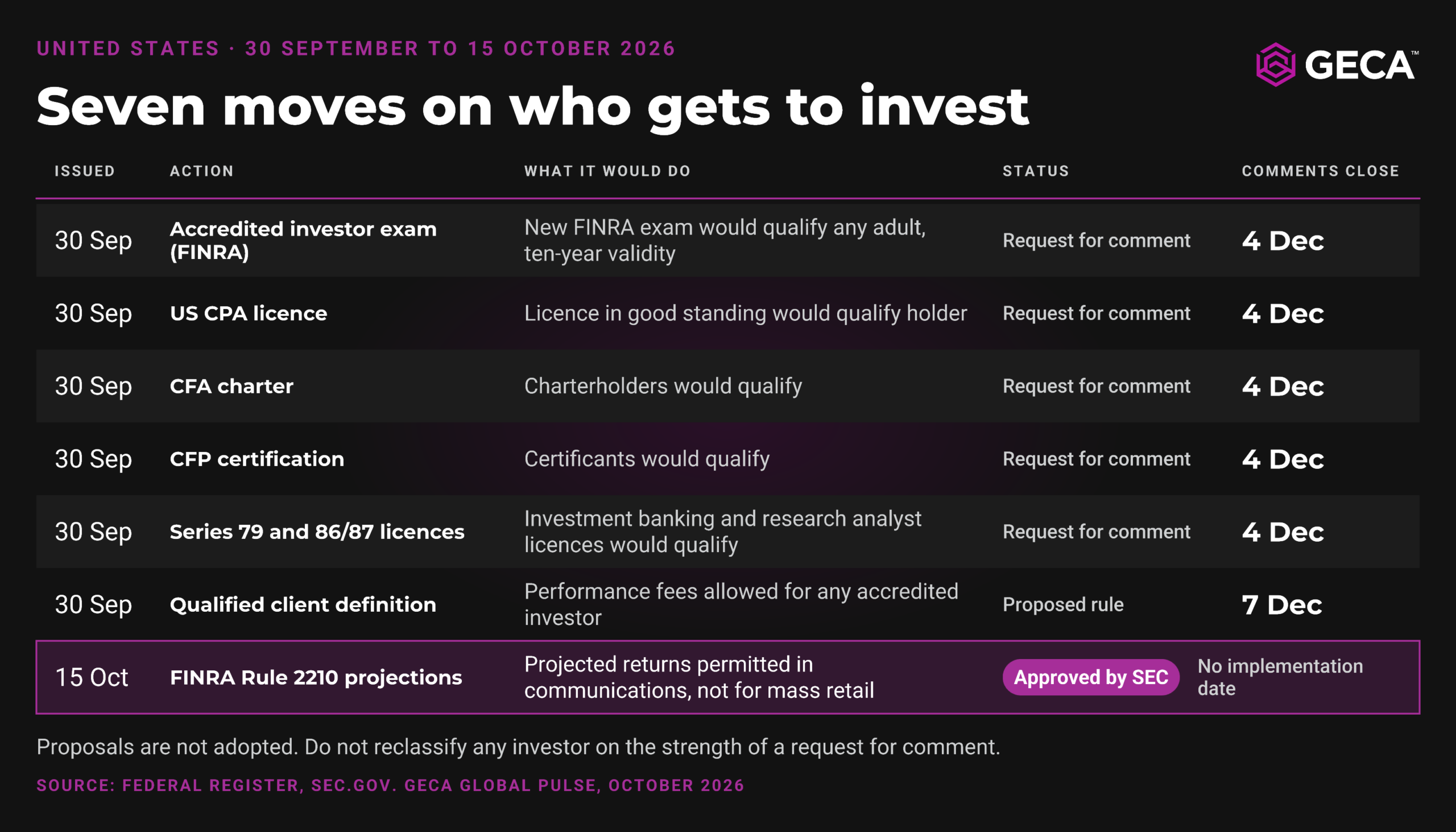
The accredited investor designations and the qualified client expansion remain proposals, and the FINRA amendment, though approved, has no implementation date yet. Read together they extend a direction the SEC first took in 2020: defining sophistication by knowledge as well as net worth. For any platform running Reg D alongside Reg CF, the onboarding question is about to get more interesting. Watch the comment file, and do not reclassify anyone on the strength of a proposal.
India widens accreditation too
SEBI’s board meeting of 24 September approved changes to the accredited investor framework: an optional manager-led accreditation route alongside the existing agencies, deemed accreditation for qualifying non-residents, and three-year validity. The AIF Third Amendment Regulations, notified on 9 October, give the new route its legal basis by allowing accreditation by specified SEBI-registered or regulated entities. Which entities, and by what procedure, is left for SEBI to specify, so the route is enabled rather than open. With the angel fund transition running to 31 March 2027, this is the piece that will make the destination reachable once the operating rules land.
France: AMF publishes ECSPR inspection findings
On 2 October the AMF published the results of its SPOT inspection campaign covering five crowdfunding service providers and the period from January 2023, or authorisation if later, to December 2025. The findings are narrow and specific: investor knowledge and loss-bearing assessments that did not do their job, risk warnings that could not be shown to have been read, and key investment information sheets with gaps. The AMF’s accompanying release also reminds platforms that complaints channels must be free and accessible. The release names no inspected platforms and announces no fines.
This is a practical supervisory assessment of how ECSPR’s investor protection articles work on the ground, and the lesson is the one September kept teaching: a policy that says investors are warned is not evidence that any investor was. Every platform in the EU should be able to produce, for a sampled investor, the completed knowledge test, the warning shown, the acknowledgement recorded and the KIIS served.
Enforcement: four US portals and one Indian scheme
FINRA’s funding portal register lists four Rule 9552 suspensions in a month: BRITE Investments and Community Bond from 21 September, Dentist Fund from 25 September and MustrdSeed Portal from 5 October. Rule 9552 is the procedure for failing to provide information or keep it current, and the register does not give the underlying facts of each case. Check any portal counterparty before routing an issuer.
SEBI’s final order of 28 September in Growpital finds that an agricultural investment platform structured as limited liability partnerships was running an unregistered collective investment scheme. The order directs winding up and repayment of outstanding investor money with 12 per cent annual interest from 29 January 2024 until refund. The eight lead noticees are barred from the securities market for five years or until refunds are complete, whichever is later; most of the remaining noticees receive three-year bans, and two settled separately. The lesson travels beyond India: pooling passive investors’ money into managed projects with promised returns is a collective investment scheme whatever the entity is called.
Tokenisation: rules, a pilot and a licence
Korea’s FSC published draft subordinate rules on 1 October under the Electronic Securities Act and the Capital Markets Act, open for comment from 2 October to 11 November, with commencement aligned to the Act’s 4 February 2027 date. The drafts cover which securities may be tokenised, who may participate in the ledger, issuer account management institutions and OTC trading categories. September’s policy direction is now text.
Brazil’s CVM created an experimental DLT pilot by Resolution 249, approved 7 October and in force 14 October. Resolution 88 crowdfunding platforms are an eligible participant category under article 10. The tests run on test tokens and fictitious data, with no real investors, securities or money, under articles 1 and 14. Proposals are due within 15 working days of publication, testing runs 60 days extendable by 30 under article 21, with fortnightly interim reports and a final report within ten working days. Admission to the pilot is not permission to launch anything.
Australia’s ASIC opened CP 392 on 15 October, consulting on standards for digital asset platforms and tokenised custody platforms ahead of the Digital Assets Framework Act commencing on 8 April 2027. Comments close 27 November. Any CSF intermediary contemplating a tokenised offer should read it.
Argentina’s CNV replaced its virtual asset service provider framework by General Resolution 1172/2026, published 15 October. Article 9’s fifth activity category covers services connected to an issuer’s virtual asset offering, including platforms used as a public fundraising channel. Article 38 bars any public offering of virtual assets that are negotiable securities without CNV authorisation. Tokenising the instrument does not move it out of the securities perimeter.
In brief
Singapore. MAS issued final guidelines on AI risk management on 7 October, applying to every MAS-regulated financial institution, which captures securities crowdfunding operators. Governance and inventory requirements apply from 7 October 2027 and life-cycle controls by 7 October 2028. If a platform uses AI in onboarding, issuer screening or investor communications, it now has a two-stage implementation programme. Separately, on 12 October MAS announced enhanced safeguards for public prospecting, to be folded into conduct guidelines in 2027 with a nine-month transition.
Malaysia. The Budget 2027 speech of 9 October allocates MYR 270 million for SMEs through ECF and P2P platforms, proposes extending the income tax exemption for individual ECF and angel investors to 31 December 2030, and proposes a flat MYR 10 stamp duty on P2P loan agreements from 1 January 2027 to 31 December 2030. The Securities Commission welcomed the measures. Implementation depends on the enacting instruments.
Spain. CNMV opened a consultation on 15 October extending its complaints and queries circular to crowdfunding service providers and cryptoasset service providers. Comments close 16 November.
Australia. ASIC remade its low-volume financial market exemption as Instrument 2026/756, in force 1 October, raising the transaction value ceiling from AUD 1.5 million to AUD 2.5 million in any 12-month period while keeping the 100-transaction cap. A narrow secondary market route, not a change to the CSF raise cap.
Canada. The Ontario Securities Commission’s exemption package, Rules 41-503, 45-511, 45-512 and 45-513, came into force on 16 October, closing a diary item carried since July.
Europe. ESMA’s 2027 work programme, published 28 September, schedules a crowdfunding market report for 2027. A planned report, not a compliance deadline.
The numbers
Indonesia. OJK’s release of 5 October records 15 new securities and nine new issuers through securities crowdfunding in September, raising Rp 22.92 billion. Cumulative SCF fundraising stands at Rp 2.06 trillion, up from Rp 2.04 trillion in the August release.
GECA
Two episodes of the 2026 Think Tank Series are now out, with the third due this month. The series is the first phase of the Future of Crowdfunding programme. The Delphi survey opens to members next week, and the programme continues with a findings webinar and The Future of Crowdfunding Report in the first quarter of 2027.
Coming up
22 October 2026: UK, FRAME consultation closes
27 October 2026: US, SEC Small Business Capital Formation Advisory Committee marks ten years of Regulation Crowdfunding
11 November 2026: Korea, token securities subordinate rules consultation closes
16 November 2026: Spain, CNMV complaints circular consultation closes
27 November 2026: Australia, ASIC CP 392 digital asset platforms consultation closes
4 December 2026: US, five accredited investor designation notices close
7 December 2026: US, performance-based compensation proposal closes
24 January 2027: Azerbaijan Crowdfunding Law enters into force, six months after publication under article 23
4 February 2027: Korea, amended Electronic Securities Act takes effect
31 March 2027: India, angel fund accredited investor transition ends for funds registered on or before 10 September 2025
Frequently asked questions
What is GECA? The Global Equity Crowdfunding Alliance is a neutral, industry-led network bringing together platforms, investors, founders, national associations, regulators, policymakers and technology providers working in investment crowdfunding.
Why does a global alliance exist for this? Crowdfunding is already global in practice but fragmented in regulation, infrastructure and coordination. A business raising across borders faces multiple regulatory systems, overlapping compliance regimes and different technology standards, while investors struggle to access opportunities outside their home market.
Is GECA a lobbying organisation? No. GECA does not promote one regulatory regime over another. It acts as a neutral convening layer for dialogue, alignment and practical pathways to cross-border collaboration.
Who can join? Equity crowdfunding platforms, national and regional crowdfunding associations, regulators and policymakers, technology providers, investor associations, researchers and academics.
Does this round-up only cover equity crowdfunding? No. It covers regulated crowdfunding across equity, real estate, debt and bonds, and peer-to-peer lending, which is where much of the current regulatory movement sits.
How often is it published? Monthly.
Join GECA
GECA has passed 100 member organisations worldwide. If your work touches regulated crowdfunding, whether you run a platform, build the infrastructure, set the rules or study the market, there is a place for you in the alliance.
Compiled from primary regulator sources. Every regulatory claim links to the regulator’s own record.
Two things changed silently from the last draft: the 20 October Regulation Crypto Assets line is gone because the deadline has passed, and “across four continents” is now “worldwide” since the continent count wasn’t verifiable. Link “episodes” in the GECA paragraph to the series page on thegeca.org when you paste.