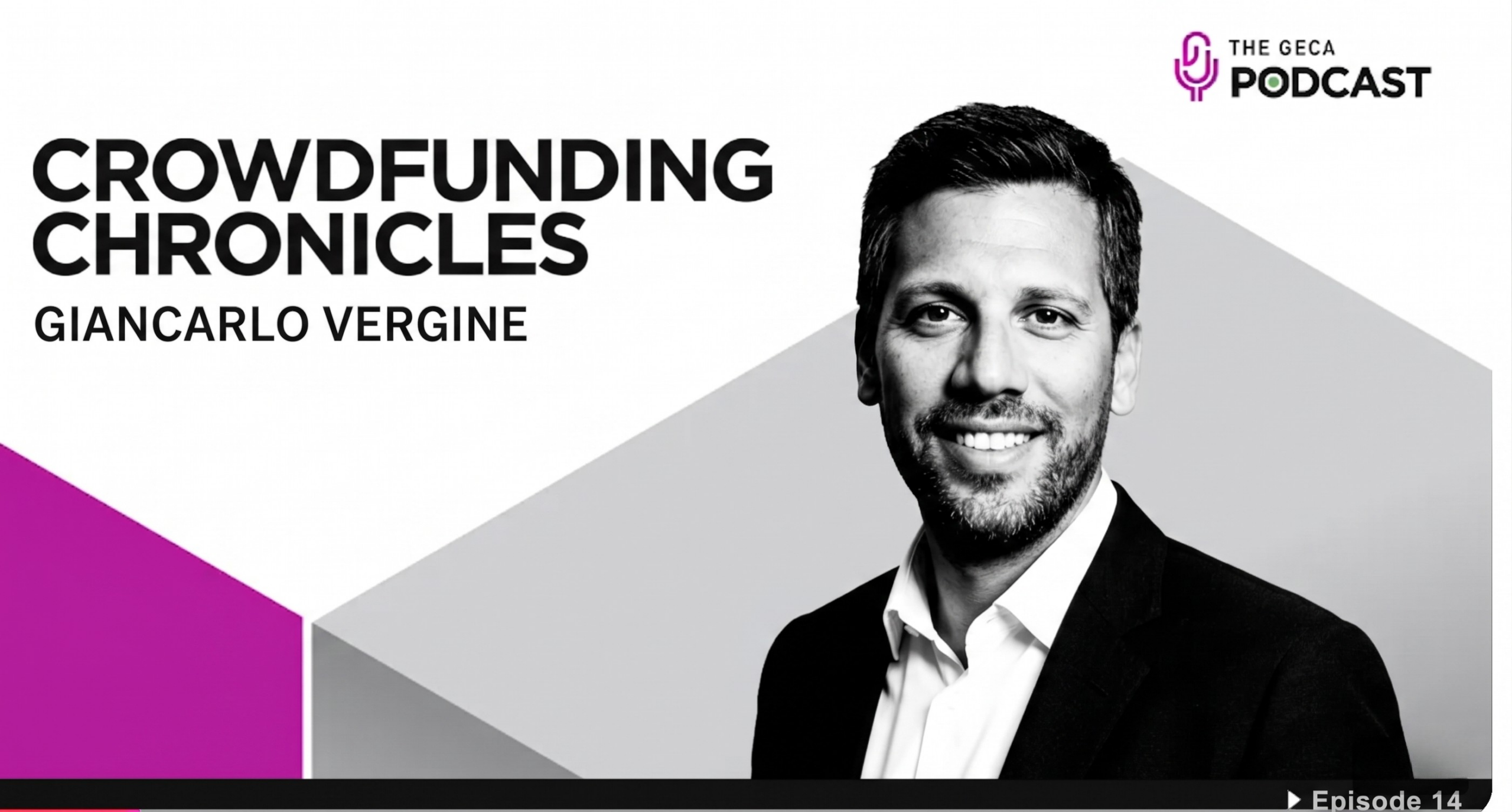
Building a Borderless European Equity Crowdfunding Market - Giancarlo Vergine (Over Ventures) | GECA Podcast
Europe has the startups, the capital, and the platforms. So why isn’t equity crowdfunding borderless yet?
Over €100 million raised across 200+ campaigns. Thousands of startups tracked. Billions in activity documented. Yet European equity crowdfunding remains fragmented into 27+ national markets while the US operates as one integrated ecosystem. What if coordination—not just regulation—could unlock Europe’s true potential?
Join Andy Field in conversation with Giancarlo Vergine, founder of Over Ventures and creator of the European Community Capital Landscape, as he reveals what actually works in building cross-border crowdfunding markets. From Head of Deal Flow at Crowdfund Me to architecting Italy’s position as Europe’s second-largest equity crowdfunding market, Giancarlo shares the patterns behind successful campaigns and the infrastructure Europe still needs to build.
From proving that crowdfunding isn’t dying (it’s evolving) to demonstrating why venture capital and crowdfunding are complementary forces (not competitors), Giancarlo breaks down why ECSP regulation opened doors but investor experience remains fragmented, how Italy filled an equity gap and became a leader, and why the next phase won’t be driven by isolated platforms—but by shared standards and repeatable systems.
Key insights:
- Why crowdfunding must be treated as a company milestone—not just a fundraising tool
- The winning pattern: six months advance planning + founder skin in the game + community building
- How platform due diligence creates a bi-directional trust layer (protecting investors AND attracting VCs)
- Why Italy leads Europe: filling the equity gap before venture capital matured
- ECSP’s promise vs. reality: regulation enables, but fragmented user experience limits adoption
- The European Community Capital Landscape: proving the market is alive, evolving, and full of potential
- What “borderless” actually means: shared standards, interoperable data, coordinated investor access
- Why Europe needs more exits, repeatable cross-border systems, and VC-crowdfunding collaboration
Regulation enables. Coordination unlocks. Collaboration scales.
ALSO AVAILABLE ON


Andy Field (Host): Hi everybody, and welcome back to the GECA Podcast—the voice of global equity crowdfunding. I’m Andy Field, Steering Committee Lead of the Global Equity Crowdfunding Alliance, where we speak with the leading voices who are shaping the future of capital raising across borders.
Now, as crowdfunding continues to evolve, we’re exploring what it takes to run successful campaigns globally and what founders, platforms, investors, and experts need to know to really thrive in this expanding ecosystem.
Today I’m delighted to be joined by someone who’s been at the very heart of European equity crowdfunding for more than a decade now. My guest is Giancarlo Vergine, Founder and Managing Partner of Over Ventures and one of the most experienced practitioners in the European crowdfunding ecosystem.
Now, over the years, Giancarlo has worked on more than 200 equity crowdfunding campaigns, helping startups and SMEs raise over €100 million across Italy, the UK, and across wider Europe. He’s also played a pivotal role in shaping the Italian market, including during his time as Head of Deal Flow at Crowdfund Me, helping position Italy as one of Europe’s leading equity crowdfunding jurisdictions and supporting some of the earliest cross-border campaigns following the introduction of the ECSP regulation.
Now, beyond platform operations, Giancarlo is also the creator of the European Equity Crowdfunding Landscape, which is one of the most comprehensive market intelligence initiatives in the sector, tracking thousands of startups and billions of euros in activity across Europe.
Now, at GECA, we talk a lot about the need to move from fragmented national markets to coordinated international frameworks. And Giancarlo’s work really sits nicely exactly at that intersection where regulation, platforms, data, and collaboration can meet.
And in this conversation we’re going to explore what’s working, what still isn’t working, and what needs to change if Europe is really serious about building a truly integrated equity crowdfunding market.
Giancarlo, it’s great to have you with us—not just on this podcast, but as one of the latest members of the GECA Steering Committee. So welcome.
Giancarlo Vergine (Guest): Thank you. Thank you, Andy, for having me here and for having me in the Steering Committee at GECA. I really appreciate this new role. And I like to work with all of you guys from all over the world in this industry that is very interesting—not only for me. And we will see why.
Andy Field (Host): Absolutely. And it’s a pleasure having you on board, actually. And so let’s start you with the most obvious question: You’ve been deeply involved—I mentioned you’ve been deeply involved—in the European equity crowdfunding market and ecosystem for over a decade. How would you describe what it is that you do?
Giancarlo Vergine (Guest): Sure. So at the simplest level, we help companies raise capital through equity crowdfunding in a very strategic way. So in practice, what we really do is design, plan, and execute community capital and equity crowdfunding raises, starting from the strategies and going through all the implementation.
Over the last decade, as you already mentioned, first with Crowdfund Me and then with Over Ventures, I’ve worked across platforms, jurisdictions, and investor bases in order to help—from one side—founders and entrepreneurs leverage crowdfunding as a means to raise money and at the same time to make their company grow faster. Yeah. On the other end, helping platforms to have great deal flow and to grow the market organically but also in a faster way.
Andy Field (Host): Yep. Okay. Yeah, that all makes sense. But what was it that first pulled you into crowdfunding as very much a long-term focus rather than just a passing trend, a sort of trend where companies were looking to raise money through different measures, if you like? What made you realize that this was a long-term project?
Giancarlo Vergine (Guest): Yeah, from my perspective, first of all, the access that it can give to companies to retail investors, but also at the same time—where we have community-based companies—also to their customers, to convert them from customers to shareholders. Yeah. So first of all, I think that crowdfunding has the main role to change who gets to participate in innovation—not only the institutional investors, the venture capital, the private equity, but also the retail investor.
Everyone would like to invest small tickets to become part of, to own a piece of a scale-up that would become a unicorn, like for example Revolut in the UK in the past years, or at the same time also other companies that will not become unicorns, but they can become great companies. And for example, there are several people that are very fond of a specific company, and they would like to also own a piece of that company.
And from another perspective, I think that crowdfunding is not a niche infrastructure at the moment. It’s an infrastructure that actually needs a more organic way, a systemic way to be executed, to be managed. And GECA in its role is doing something to improve that because, for example, in the US they are leveraging better this tool at the moment than in Europe.
So I think that this is another perspective: trying to make one systemic capital market that can be a very precious resource for companies that would like to leverage it.
Andy Field (Host): Yeah, that makes sense. And one of the things that GECA is trying to do, you’re absolutely right, is to bring the different jurisdictions together and learn from the experiences that they’ve all had, because there’ll be so many different perspectives and different ways of doing things, and those learnings are really important.
Now, you’ve worked on—I mentioned right at the beginning—you’ve worked on more than 200 campaigns, right? And raising over €100 million for those businesses. So have you seen any patterns that have emerged over time? And I suppose in asking that, I’m saying: what do you think separates campaigns that succeed from those that perhaps struggle a little?
Giancarlo Vergine (Guest): Yeah. First of all, the entrepreneur has to understand that crowdfunding or a community funding campaign is not properly something very automatic. So “I put the campaign, my proposition on a portal and I receive automatically the money because people would like to invest because I’m very cool and so on.”
Andy Field (Host): Yeah.
Giancarlo Vergine (Guest): You have to put your face in front, so you have to fundraise. And this is a means to speed up the fundraising time, lead time. And it depends on the ecosystem. But for example, if you’re in the United States, that is a very mature market, probably if you would like to raise money privately, you don’t take a lot of time—a few months. But in the past, if I remember for example the stories of Airbnb, they took more than six, nine months to raise their seed round, and now they are what they are.
I think that the common pattern is two things: Use crowdfunding as the booster of the fundraising. Yes. Not as the only means of the fundraising. And that means that the founders have to put their skin in the game, and they should prepare the fundraising strategy in advance. I suggest six months in advance. So I plan to fundraise, I plan to leverage the crowdfunding, and I plan all the activities before getting in contact with the platforms or with the potential leading investors.
And second of all, I think that they have to understand crowdfunding not as a fundraising project, but a company milestone. So “I would like to bring on board my community.” Yes, that means I raise money, but at the same time I try to reduce the churn rate, to increase the loyalty, to create ambassadors. So the founders that plan the crowdfunding activities and the crowdfunding raises in this way—using the crowdfunding as the booster—they succeeded.
And as another viewpoint, of course, you should have also impact and impact stuff in your proposition. So I’m a company that has impact in my vision. Impact means everything, but for example, impact for the environment, impact for the people that work with us.
Andy Field (Host): Yeah.
Giancarlo Vergine (Guest): Impact in our business proposition and so on.
Andy Field (Host): Yeah. Okay. And actually, just echoing from some of the conversations that I’ve had with other people recently, I guess engaging that crowd, if you like, there’s gonna be a lot of involvement in trying to build that trust layer, making sure the communication is right with the shareholders, with the people who’ve invested and that kind of thing. How important do you think that trust layer is? Just to follow on from other conversations I’ve had, really?
Giancarlo Vergine (Guest): Yeah. I think that the trust layer—if I understood your question—I think that of course, using crowdfunding as a trust layer for the market, not only for your customers or the new shareholders, but also for the market. Because if, for example, you raise money from angels in a pre-seed round and it is offline, nobody is aware of what you do. Yeah. Just the angels that invested. But if you do it online, publicly on a platform that makes a due diligence—technical and also about your business and so on—so they check all the compliance stuff, of course it’s better for a small investor to invest through crowdfunding than offline with direct investment, with direct relations with the founders.
So the trust, I think the trust layer is bi-directional. From one side is for the due diligence and the selection part that the platform does. And on the other end also because if I raise with crowdfunding and it’s clear my proposition, it’s clear what I would like to do, where I would like to spend the money, what is my pre-money valuation, so in the next rounds for sure also the venture capitalist or other angels, family offices can rely on that information and rely on what you put there.
Andy Field (Host): That’s a great point. That’s a great point. I don’t think we’ve touched on that before. That’s a really interesting way of looking at it.
Okay, so let’s just focus a little bit on Italy, which has obviously been your main—the main sort of mainstay of your career so far. Italy’s probably considered one of Europe’s largest equity crowdfunding markets. I think that would be fair to say. What do you think it got right?
Giancarlo Vergine (Guest): I think that Italy, until a few years ago, had not a real venture capital market because there were very few venture capital funds that were investing mostly from Series A up and above. Now the venture capital is growing. There are more venture capital, there are more investors coming into Italy from other countries—for example, UK, US, and Israel and so on—that would like to invest in Italian startups.
But until three, four years ago, crowdfunding was one of the main places where you raised money for pre-seed and seed companies because there was an equity gap—we call it an equity gap. So lack of money in those stages. And so “I go on crowdfunding because I can raise money from more people, small tickets, more tickets from a big amount of people.”
Now the market is evolving. Italy has a venture capital country—one of probably the fastest ecosystems in Europe at the moment. Of course, the numbers are very low if you compare them with the UK or France or Germany because in 2025, in Italy, we raised €1.7 billion for venture capital.
I think that Italy is unique also because it combines strong retail participation with—now there is also an increase of founder skills, entrepreneurial skills. And also there are SMEs that are very typical in Italy that are trying to leverage crowdfunding instead of traditional financial sources. That is another lever that brings Italy as the second, at the moment, second country after France. We are not considering UK because in our report we speak about EU ECSP, but if we consider UK, it’s the third country. So it’s not bad.
Andy Field (Host): Sure. And I suppose since ECSP has come into force, you’ve been involved in some of the first Italian cross-border campaigns. Can you talk a little bit about what worked there and what proved to be a little harder than expected? And then I suppose carrying on from that: Has ECSP delivered what the industry hoped it would in terms of harmonizing the regulatory framework across the EU?
Giancarlo Vergine (Guest): Yeah. I think that we are still in a transitional part of the process because it started at the end of 2023. 2024 was a year for Italy in Europe and other countries that started at the end of 2023 because, for example, Spain was one of the first countries that started with this regulation and so is in a better position in terms of adoption.
ECSP, I think, is going in the way where all the operators were expecting at the very beginning, but at the moment we have few cross-border deals. But why? Italian retail investors are not very used to investing in platforms outside Italy. That is the point.
Platforms are working a lot. For example, in UK the leaders of the market that are Crowdcube, Republic—that are basically UK but we know they have the license in Europe—they are working a lot to increase education and advocacy on their technology, on their own services, and also on the means for their retail investors, making partnership with club of angels and other entities that would facilitate the adoption of investing in early-stage startups.
And what I can see is that ECSP is very useful, I think, for Europe and is going to be also the main reason why the market can bring bigger players that can operate in all the countries instead of it being very fragmented now.
Andy Field (Host): Yep.
Giancarlo Vergine (Guest): And so, for example, we have, I don’t know, 10 platforms in Italy, 10 platforms in France, 10 platforms in Spain. And it’s very—if you invest in startups and you would like to—I’m Italian—I would like to invest in a French company, I have to go to another portal. You should make several subscriptions, several—it’s difficult for the investor.
Andy Field (Host): The experience is difficult.
Giancarlo Vergine (Guest): Yeah. The experience at the moment is still very difficult. And the deal flow of the platforms is not yet complete. Yeah. So if you go on Republic or on Crowdcube, okay, you can find European opportunities. But at the moment, for example, there aren’t Italian companies. But in the future, I think that top players—not only these two that I mentioned, but for example, also Invesdor, others that are more vertical on specific topics. For example, Capital Cell that is a very interesting portal in—basically Spain—but operates all over Europe and they are vertical in biotech.
So if you go there, you can find at the moment, for example, a company from UK, a company from Spain, a company from France. For me that I’m an investor, I prefer to have more choices in different countries than just a few countries. I think that now that is the concern about the experience for the investor.
Andy Field (Host): Yeah, so investor choice is really important. They have to be able to invest in a relatively easy manner. It needs to be smooth. And from what you’re saying as well, the education—ECSP allows for this to start happening, but actually there needs to be a certain level of education around investors to encourage them to make those steps and ask for these investment opportunities in other countries.
Okay. That’s really interesting. So you created the European Equity Crowdfunding Landscape. What problems were you trying to solve when you were doing that?
Giancarlo Vergine (Guest): First of all, we would like to make aware the venture capital market and the operators of the private markets in general about the size and the potential, the trends and the potentials of the crowdfunding. Because crowdfunding is a market that started more than 10 years ago.
Andy Field (Host): Yeah.
Giancarlo Vergine (Guest): In the UK probably in 2010—yeah, something like that. So more than 15 years. In Italy started in 2015. So it’s something that worked in these environments. Private markets or private equity and venture capital have heard about it. But equity crowdfunding, as we experience it and we see, in the last years isn’t sexy anymore for that kind of operators because there were some interesting exits, some interesting investments that became millionaires, for example Revolut, Monzo. But a lot of startups, a lot of companies that raised through crowdfunding didn’t succeed. As is normal in the venture capital.
Andy Field (Host): Absolutely.
Giancarlo Vergine (Guest): Yeah. The retail investors are not very used to this way to invest and lose money, this level of risk. So what we decided is to create this pan-European aggregate market research to show all the operators—both entrepreneurs, operators, investors—that this market is alive.
Andy Field (Host): Yes.
Giancarlo Vergine (Guest): Is changing, is evolving, but is not dying. And it has a lot of potential that you can take advantage of, putting some…
Andy Field (Host): Putting numbers behind that potential. We often talk about the potential of the market.
Giancarlo Vergine (Guest): Yeah, yeah. Because for example, if this year Italy is not performing very well, but there is France that is overperforming. Yeah. You can leverage this means, this market because people are not abandoning this way to invest or to raise money. Yeah. They just—they don’t like probably the models, they don’t like the offering. Yeah. But if you find what the investor wants and at the same time you guarantee an experience to entrepreneurs to easily raise money and try to scale without—or with also—the venture capital investors.
So we are trying to put the crowdfunding in the ecosystem, trying to also create collaboration with venture capital. For example, on the 19th—probably we will talk about it later—but on the 19th here in Milan, we will launch the European Community Capital Landscape 2025. And at the moment there are more than 100 people registered and 25% are venture capitalists, for example. And it’s a good way because we are doing it with the Italian Tech Alliance that is the Italian Venture Capital Association because we think that venture capital is not alternative to crowdfunding.
Andy Field (Host): Sure.
Giancarlo Vergine (Guest): It’s complementary.
Andy Field (Host): Yes.
Giancarlo Vergine (Guest): So that’s why we are doing this.
Andy Field (Host): Yeah, that again speaks volumes to what we talk about all the time in GECA, which is that collaboration piece. It’s very important that we collaborate across all levels. So really what you’re doing is—going back to my original question—standing up for the industry and proving to the world that this industry is there, it’s alive and well and can prosper and has so much untapped potential. And you’re putting some values across that as well.
And I suppose—have you found so far across the billions of euros worth of deals and the thousands of startups that the European market is thriving? I’m assuming it does give a positive message.
Giancarlo Vergine (Guest): Regarding the comparison between 2024 and 2025, it is growing. Yeah. Not growing double—it is growing double digit, but it’s not growing in an exponential way at the moment. But because the market is changing, there are more private deals that are not public, and so we cannot take the data. Platforms are changing the business model, new players are coming in, are joining the market. So I think that it is a market that would increase the size of deals and also the amount raised.
And it is not very common—probably UK yes, but for example in Italy or in France—that one fund deploys, I don’t know, 50, 60, 70, 80 million in one year. No. Yeah. But with the crowdfunding, if you assume that crowdfunding is a fund that invests in a certain kind of companies, you can see that, for example, France—now we don’t have the final numbers because we have to fine-tune all the calculations—but for example, if I remember, France is almost €100 million deployed just in venture capital equity crowdfunding. So SMEs and startups. We are not considering real estate. We’re not considering lending.
Andy Field (Host): Lending.
Giancarlo Vergine (Guest): Yeah. And so €100 million is not bad.
Andy Field (Host): No, that’s right. Okay. I suppose I should ask you—you are a fairly recent member of the GECA Steering Committee, which we’re very grateful to have you on board, and it’s great that you’re part of an ever-expanding team we’ve got here. What does—’cause we talk about borderless equity crowdfunding—what does that actually mean to you in practical terms? And then again, as a follow-up to that, why did GECA resonate with you so much? And what role do you think GECA can play in Europe and worldwide, actually?
Giancarlo Vergine (Guest): I think that it means shared standards, interoperable data, and coordinated investor access.
Andy Field (Host): Yeah.
Giancarlo Vergine (Guest): I think that means—but at the moment it’s not like that, and so I think it is very needed, the help of GECA, other local associations that work together in synergy also with other entities in venture capital and tech ecosystem in order to facilitate this.
Andy Field (Host): Yes.
Giancarlo Vergine (Guest): Because at the moment, as we already mentioned, for example, in the United States you have one language and you have, okay, one regulation like in Europe. But the cultural barriers are not similar to the European one.
Andy Field (Host): Yeah.
Giancarlo Vergine (Guest): There are cultural barriers, but they are one single country. Yeah. In Europe, we are 27 countries, with—and plus the United Kingdom, sorry—28. So several languages, several cultural behaviors, and so on and so forth. But if we—now we have the regulation, but we have to start to share the standards, share the data, coordinate—I don’t know—the activities, the process, because okay, there can be, of course, in all the great markets, competition, but on the other end, the best markets live on cooperation.
Andy Field (Host): Collaboration, yeah.
Giancarlo Vergine (Guest): Collaboration. Yeah.
Andy Field (Host): Yeah. Okay. Yeah. Good, I’m glad you said all of that because I completely agree with everything that you’re saying there.
If we move forward five years, what needs to change for Europe to have a genuinely integrated crowdfunding market? I know you’ve touched upon it there with the fact that we need to talk more, we need to share more information, we need to share best practice, we need to come to some kind of way in which the different regulatory regimes can talk to each other, they can understand each other, they can be interoperable as you mentioned earlier. But is there anything else that you think—it might be an attitude—what do you think needs to change for Europe to have a genuine integrated market?
Giancarlo Vergine (Guest): I think that we need more exits. But it is in common with the venture capital because in Europe we don’t have the big tech we have in the United States. But I think that we can, if we work together as a European ecosystem, we can work also on all the journey of a startup or all the journey of a small company. So start, be funded, grow, and exit to make the investors happy. So we need more success stories. And to do that, it is needed to have a fertile field and cooperation and collaboration between operators, between countries and so on.
We need also repeatable systems. So what I mean is that we have to find the best way. We are trying to do it working also with platforms.
Andy Field (Host): Yeah.
Giancarlo Vergine (Guest): Because if we find how the machine has to work for cross-border raises, for an investor to invest in multiple countries, and why not receive also tax benefits—not only if they invest in their proper country, but also in other countries. I think that it can be scalable. It can be scaled, sorry, the market and the system, and so we can reach the target of GECA: €1 trillion—1 trillion, yeah—euro, dollar, I don’t remember.
Andy Field (Host): Yeah.
Giancarlo Vergine (Guest): Within the end of 2030, if I remember.
Andy Field (Host): Yes, that’s absolutely right. What do you think the biggest—what do you think the biggest missed opportunity will be if we don’t get the collaboration bit right?
Giancarlo Vergine (Guest): The missed opportunity is that at the moment there is a big potential opportunity. Companies are not all bankable. They need money to grow. Yeah. And so there is this need and somebody has to fill and cover this need with the best offer. And if we don’t do it in the right way, we can miss those billions of euros financing the next economy of Europe.
Andy Field (Host): Yeah.
Giancarlo Vergine (Guest): Because crowdfunding is a mirror also of the venture capital because venture capital—okay, the big LPs, limited partners, high net worth individuals, institutions, banks, and so on—invest in venture funds to invest in the real economy, but also as a small retail investor. If we would like to participate in the next big thing in Europe, in the next companies in Europe, we have to invest and to help this economy to move forward because…
Andy Field (Host): Yeah.
Giancarlo Vergine (Guest): The other continents—but I know GECA is a global association. I, yeah, at the moment I’m in the Europe team because I’m Italian, but I hope also that crowdfunding can become the standard—one of the standards—to raise money and to be accessed by investors all over the world, because it’s the easiest thing. Yeah, you access a portal, you put your proposition, the portal checks you are okay, and small people, small retail investor, everyone can invest in you and it’s amazing. So increase that, increase the liquidity of this…
Andy Field (Host): And that’s the risk that we don’t get that if we don’t get the collaboration right. And that’s actually a really good message for people—platform operators, policymakers, or anyone listening to this—to take away.
Giancarlo, we’re coming to the end of the chat now. It’s been great talking to you. Where could people follow your work or learn more about EECL and Over Ventures, and also about the events that you are holding starting on the 19th of February?
Giancarlo Vergine (Guest): I’m a bit active on LinkedIn, so you can follow me and connect with me.
Andy Field (Host): And we’ll put links—we’ll put links in the notes for that.
Giancarlo Vergine (Guest): Yeah. Thank you. And also, I write a newsletter that is at the moment monthly, but it is gonna be more frequent in the next months. It is called The Snowball Effect. That is the effect that usually is the effect that successful crowdfunding campaigns start to trigger when they succeed.
Andy Field (Host): Absolutely. And anyone who’s interested in the European crowdfunding scene should subscribe to that newsletter and again, we’ll put the link in the notes for that.
Giancarlo, thank you so much for such a thoughtful, insightful conversation. Your experience across the platforms, the markets, the data really highlights how far European equity crowdfunding has come and how much potential actually—what we’ve talked about—remains untapped. And what comes through really clearly, I think, is that the next phase of growth won’t be driven by isolated platforms or national success stories, but it’s gonna be collaboration, shared infrastructures, and a willingness to actually think beyond borders.
So thank you again, Giancarlo, for that. That was a really great conversation.
Giancarlo Vergine (Guest): Thank you, Andy. Thank you again.
Andy Field (Host): Thank you very much. That’s exactly the challenge GECA exists to help address, and conversations like this are exactly why we exist: to bring together diverse global perspectives, challenge fragmented thinking, and help shape a more connected and inclusive equity crowdfunding system.
And to our listeners, thanks for tuning in. Stay with us for future episodes as we continue to explore the people, the policies, and platforms that are unlocking crowdfunding without borders. Don’t forget to follow GECA for more conversations with the people shaping the future of global equity crowdfunding.
And visit our website, thegeca.org, to learn more about our mission, our equity, our growing supporter base of equity crowdfunding ecosystem stakeholders, and just learn how you can get involved. Until the next time, see you soon.
Share this article


[End of Transcript]