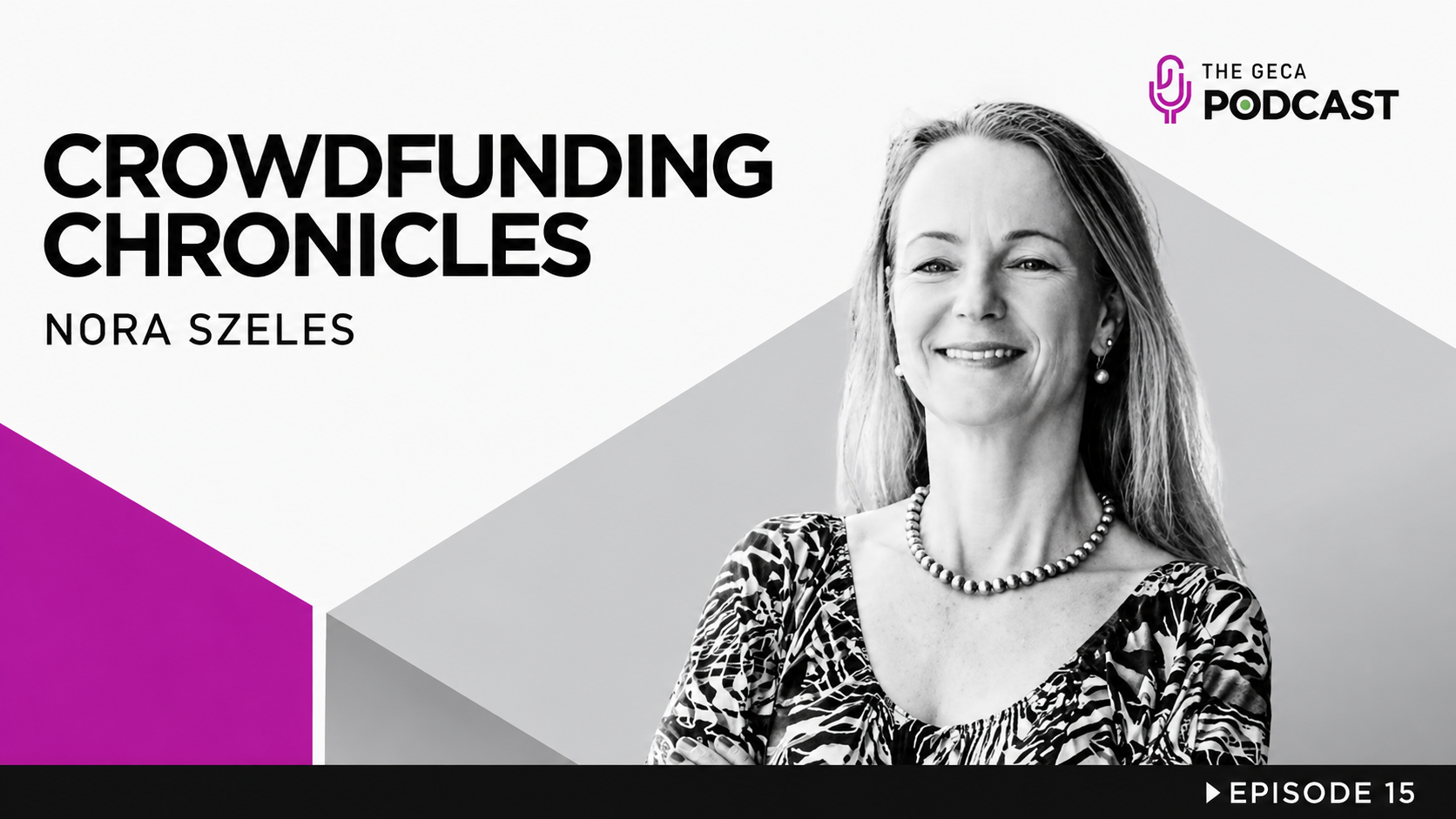
From the Trading Floor to Tokenization: Nora Szeles on Democratizing Capital Markets | GECA Podcast
What if the real key to unlocking equity crowdfunding isn’t regulation – it’s retail investors?
From open-outcry trading floors at the Budapest Stock Exchange to building one of Europe’s most ambitious cross-border crowdfunding platforms under ECSPR, Nora Szeles has spent her career proving that capital markets work better when ordinary people participate. Her vision: democratize access to funding and investment, disintermediate the banking system, and build an ecosystem where founders and savers benefit – not just institutions.
Join Andy Field in conversation with Nora Szeles, CEO of TokePortal and one of Europe’s most active crowdfunding voices, as she shares hard-won lessons from market crises, regulatory battles, and the operational realities of going cross-border. From relocating from Hungary to Malta for regulatory responsiveness to launching the First Crowd Incubator to make startups “crowdfunding ready,” Nora breaks down what’s actually working in European crowdfunding – and what’s still broken.
Key insights:
- Why retail investors stabilize markets during crises (the lesson from the 1998 Russian crisis)
- How the JOBS Act and ECSPR draft transformed her vision for crowdfunding
- Why TokePortal relocated from Hungary to Malta – and why a license is just the beginning
- The real barriers to borderless crowdfunding: share issuance, secondary trading, costs, tax
- How tokenization and Web3 can solve cross-border friction (when adoption catches up)
- Why financial literacy and alumni-based founder culture matter for ecosystem growth
- The First Crowd Incubator: making startups crowdfunding-ready in Malta
- Why crowdfunding is inclusive – not alternative – to other funding sources
Democratize access. Disintermediate the system. Build the ecosystem from the bottom up.
ALSO AVAILABLE ON


Andy Field (Host): Hello, everyone, and welcome back to the GECA Podcast—the voice of global equity crowdfunding. I’m Andy Field, Steering Committee Lead of the Global Equity Crowdfunding Alliance, or GECA, where we speak with the leading voices who are shaping the future of capital raising across borders.
Now, as crowdfunding continues to evolve, we’re exploring what it takes to run successful campaigns globally and what founders, platforms, and investors need to know to thrive in this expanding ecosystem.
Today I’m delighted to be joined by Nora Szeles, CEO of crowdfunding platform TokePortal. Nora is one of the most active voices in the European crowdfunding ecosystem. She’s been deeply involved in the evolution of the industry—from building a platform under the ECSPR framework to launching initiatives that support the next generation of startups and investors.
So welcome, Nora. It’s great to have you here.
Nora Szeles (Guest): Thanks a lot. Thanks a lot for the invitation, Andy.
Andy Field (Host): No problem at all. It’s always great to talk with you. Perhaps we could start with a little about your journey into crowdfunding and what drew you into the industry in the first place.
Nora Szeles (Guest): Okay. Ever since I can remember, I’ve been in regulated capital markets. I started my career when I was about 20 at the Budapest Stock Exchange, when it was reopened after the communist regime. I was still a student, and I got hooked there immediately. I worked for the stock exchange and we launched derivatives trading a few days later.
After the first stocks were listed, we started to look at derivatives. I knew that all around the world derivatives are being traded. I had a great mentor—a professional and professor of derivatives trading and pricing at Corvinus University of Budapest—who then became a board member of the stock exchange and asked for my assistance to launch the futures and derivatives trading. That was a success against all odds.
I remember that brokers told me on the floor—it was still open outcry—that no one would trade. “Who will trade futures and options here when there are only a few securities?” And I told them, “You guys, you are going to do this job.” And that’s what actually happened.
As a rule of thumb, everything in capital markets works better the more aligned you are with your peers. It’s not about regulation that should divide us. We should be competitive with the product and the pipeline, and these local stories should matter at the end of the day. We shouldn’t deviate in terms of regulation from more developed markets. That’s what I learned.
At that time, there was no internet, nothing, so I had to travel to other marketplaces to see how they work. This is how I was socialised in capital markets. We have to be very good at regulation, and then product development should remain and become competitive locally.
The other important observation came with the first crisis. After I left the stock exchange, I became a broker—a derivatives broker. I was on the floor during the Russian crisis, actually eight months pregnant. At that time we thought that was what crisis meant—that half-year-long Russian crisis when the Hungarian index, called BUX, lost two-thirds of its value within a few months.
I saw many people getting ruined. That completely changed my mindset when I observed that the fall on other markets—like the Polish market, which is supposed to be very much related to the Hungarian, especially from a Western institutional investor’s point of view—the Polish market fell much less. Other markets in the area also fell less than the BUX.
What we came up with as the reason was that the participation of retail investors in the market—as owners of shares—mattered a lot. The retail investor doesn’t release stop-loss orders when everything has to be sold no matter what the price. They sit and wait. Of course, some liquidate positions, but it’s not a coordinated huge sell order to the market that further deepens the crisis.
That was an extremely important recognition for me, because I heard as a broker from other brokerage companies in Hungary that “the London institutional investor is the god.” Because of course, with one single order we earn the revenue for a year. To go into retail is extremely cumbersome, very costly, and very risky—small tickets don’t pay off, et cetera. All brokers at that time focused on institutional investors. And when an institutional investor takes action in a crisis, it’s always a stop-loss order, which ruins everything in the end.
That was the first observation. The second was very local to the Budapest Stock Exchange. Although I do absolutely respect the pioneering work they did in relaunching the first communist-regime stock market—it was actually a relaunch, because there had been a huge, fantastically developed stock market before, earlier than the Second World War. There’s a recent development I would really love to share later about research into the old Budapest commodity and stock exchange.
The second observation was that we all thought—I mean, we as 20-year-old, green-eared newcomers, of course less than very well-respected experts in the leading positions—but everyone thought that issuers would just ring on the door and ask to be admitted to stock trading. As if companies are born big and profitable, and they all stand and queue up begging the stock market operator for access to the trading floor. Actually, the opposite is true.
I always thought: why do you guys think big companies will always be in the pipeline when you don’t have young companies becoming big, and there’s no service available for them? The demand was there from young companies, and they were rejected. The demand on the investor side wasn’t nurtured either—many young retail investors had no appetite because brokerage companies had no appetite for them. So that side was also totally underserved.
I thought that if this continued, there was no real future for the stock markets—and actually, that has become true, though I wish it hadn’t.
I gave up on capital market development on the incumbent side. We started to criticise the stock market strategists, and a few colleagues and I were vocal about it. Then suddenly the Federation of European Stock Exchanges nominated me and my colleague Marosi Gabor for the Young Researcher of the Year Award. That was a long time ago, but even since then, no Hungarian has won that prize. We won because we were right in forecasting that it wasn’t going to continue.
Our third assumption was that there was no cross-border collaboration. It was instead a very primitive jealousy—whether the Polish, Prague, or Belgrade stock exchanges should lead a coalition. This is where it all got stuck. So all three columns—demand side, supply side, and cross-border side—got stuck at that time.
I decided to leave because I wasn’t able to change this. Then the JOBS Act was enacted in the US. I was invited to a “crowdfund university” lecture when one of the fathers of the JOBS Act—successful laws always have several fathers—came to deliver a lecture at the Budapest Stock Exchange. I read the regulation, and I thought it was a good regulation. I understood what it meant: they had lifted the bar for the issuance of early-phase companies.
When you think about it, even retail investors in listed companies isn’t a very old story—it wasn’t until the 1940s when Merrill Lynch roadshowed across the US for retail investors in listed stocks. Before that, it wasn’t even popular, much less regulated. So I thought the JOBS Act was a really historic milestone. I realised it allowed private companies to do small IPOs—IPOs for private companies, which had never been the case before.
Then I heard there was a European initiative already going on, which is why I started to follow it. When the draft of the ECSPR appeared on the European Parliament’s website on the 7th of March 2018, I read the draft and thought it was going to be a good regulation. So we raised a little money to prepare the launch of TokePortal—far too little money. I was too optimistic to launch the business. That’s the story in a nutshell. I hope it made sense.
Andy Field (Host): It did make sense, and it was a great timeline as well. So you started TokePortal in Hungary, and later moved to Malta more recently. What drove that evolution, and what were the strategic reasons behind that move?
Nora Szeles (Guest): Of course. As I detailed earlier, I was always regulated by the National Bank of Hungary—because of the stock exchange, and later as a broker. I also worked as an asset manager, which I didn’t mention. So I never had a problem with the National Bank of Hungary. It was at that time a relatively well-established, knowledgeable institution.
But before crowdfunding, there was a huge brokerage scandal here in Hungary where brokers cheated on retail investors. People actually demonstrated on the street because they lost all their money. The National Bank of Hungary became very cautious—which sounds positive, but really they became very negative around anything involving retail investors. They didn’t reject crowdfunding outright, and nowadays I think they’re much more open to it again. But we simply didn’t get answers for an entire year, although we had a normal relationship.
To be honest—although it’s not private—the reputation of Hungary deteriorated in those times. Since we always wanted to go international with crowdfunding, we thought it was time to look around and consider relocating. We interviewed a few regulators, and I really liked the approach of the Maltese MFSA.
Several Hungarian companies were already established there, as well as companies from other countries. Malta wants to position itself as a financial hub, and it has the resources. I like the size of it—it’s even smaller than Hungary, so I feel comfortable. Of course, it’s not perfect, but it’s relatively supportive, and that’s very important. I don’t mind if it’s a Hungarian, Maltese, Latvian, British, or Swedish license. At a certain point, we had to decide because the regulation enacted a very strict deadline that we were already behind. So we decided—it was a bit speculative—but it’s worked out nicely. We’re getting established there.
However, I have to say it is by far much more than simply obtaining a license. The regulator expects you—and we also wanted to take the opportunity to develop the business in Malta. But you have to learn and employ not only the regulatory side but the entire corporate law, the local ecosystem, company service providers, et cetera. So it’s not at all only a license—it’s a completely new setup. We’re now doing this job “riding on two horses,” as the Hungarians say, which is exhausting—but exhausting at a higher level than I thought.
Fortunately, it looks like now we’re raising funds to build capacities. The way I see ourselves, we are where we should have been two years ago, but we’re finally there. From now on—especially with the help of initiatives like GECA, Eurocrowd, EDFA, and other important international associations—it’s so much fun to detect how much we share the same mission. We don’t only learn from each other; we share originally the same mission.
That’s why it’s also fun, and it’s a huge learning curve. Against all currently existing boundaries, we’ll address it here in this podcast, and we’ll also talk about it at the upcoming conference in Málaga—which you can link in the podcast description. We all want to join forces to conquer these obstacles. Not only legal ones, which still exist despite the cross-border nature of ECSPR, but also mental, cost-related, tax-related, and many others.
Andy Field (Host): Yeah, you’re right. In order to see the benefits of the unified European framework that exists in theory, we’re still some way from unlocking the potential. Some of those complexities we’re coming together to solve. That’s the benefit of meeting people who share common goals—together we’ll create that noise and try to make it happen.
So we move nicely onto the European crowdfunding ecosystem. You’re really active across the European startup and crowdfunding ecosystem—you’ve mentioned some of the organisations you’re involved with. From your vantage point, what really encourages and excites you most about where the industry is heading?
Nora Szeles (Guest): As I said, my absolute mission is to conquer borders, and to nurture and serve demand from the bottom up. I believe that due to digitalisation—every aspect from the simple internet to blockchain and Web3 technologies—we now have all the tools in our hands that can democratise. And it’s not an empty word; it’s a very important mission. To democratise access to funding and also to investments, to enhance financial literacy.
Honestly, I am in a fight all the time with the banking system. I don’t like when intermediaries make more money than the ultimate savers, and that’s actually what I observe. I would like to disintermediate as much as possible—not at the expense of risk management and knowledge, but to decrease costs and leave more money, more knowledge, more profit with the saver.
One of the tools to do this is crowdfunding, which enables an ecosystem to grow from the bottom up because the barriers to entry on both sides of the marketplace are much lower than ever before. You can start investing with as little as €100 to join a story—a prospect of failure in most cases, but sometimes a growth story. And if you’re the founder of a company with three people but you have something already on the market, traction, mission, and the drive to create something, you can raise funds directly to convert your network—to monetise all that traction.
That’s the competition. That’s the kind of mission that drives me since I detected the problems with incumbent capital markets when I was younger.
Andy Field (Host): So making this available to everybody—democratising this type of finance—is obviously a passion.
One of the things that we talk about at GECA is the idea of borderless crowdfunding. From your experience, how close do you think we are to actually making that a reality? Obviously it’s possible, but how do we make it a little bit more mainstream?
Nora Szeles (Guest): Look, everything is connected with everything, and I don’t want to complicate my answer. But of course, the legal framework enables us to offer services across borders. It means we don’t have to obtain further licenses to market our offerings or enable a startup or SME to launch a campaign from another EU country on our website. It just goes through at one single point of entry under our own regulated conditions. That’s the basics.
But this isn’t enough to succeed. It’s very important that the financial literacy and financial ecosystem—the interconnectedness, the alumni-based culture where successful founders and successful crowdfunders start to reinvest in companies that come after them, sharing knowledge, becoming real role models—it is coming. The pattern is strengthening, but not enough. So associations like yours have this mission to build bridges and to communicate, to elevate, to elaborate—to make it visible. Raising awareness for these problems.
What I would like to say: tomorrow I could launch a campaign for a Turkish company and propose it to Maltese investors, for example. The campaign can be successful because tickets are relatively low. Hypothetically it could be as big as €5 million, but in capital market terms that’s still little. The average round is still below €1 million. If you do your job well, you can do this because you know your community. You can also do some manual pairing of investors with founders. One by one, we can absolutely create success stories of cross-border investments.
If, for example, this Turkish company wants to sell its services to Malta, then it’s very obvious they can try to raise funds for that purpose, because a Maltese investor would eventually believe they will have hands-on benefit from the investment—not only financial, but enabling this Turkish company to offer that service in Malta.
The problem comes afterwards. For an equity campaign—which is what GECA is for, and what I myself am for—how do you issue the shares, at what cost? How do you allocate them, at what cost? And if they want to trade these shares—making them not only hypothetically transferable but available on the secondary market as a real option to exit earlier, independently from the founder, which is the original exit strategy of startups in general—there are huge problems already. Costs are extreme, services are hard to access if at all available. Some investors get fed up that they have to wait a long time for their shares. They know they can’t trade them yet—because it’s a startup, not a stock market—but it’s annoying that it’s not easily handled.
Then let’s say this Maltese investor wants to sell shares—let’s say 20, no matter the volume—of this Turkish company to a Swedish investor. That’s a nightmare.
Digitalisation, tokenisation, and Web3-based technologies can all help with this, but the penetration of such services isn’t good enough yet. We have to build capacity to learn and then employ it smartly and compliantly. That’s what has to be implemented. I think that’s one of the biggest problems.
And then taxation, which will never be harmonised, is also another problem. Bigger cheques aren’t written in crowdfunding due to taxation differences and obstacles. That’s another issue to address.
Andy Field (Host): All of these things we’re talking about are certainly on the agenda of discussion points and working groups for GECA, and we’re making a start on addressing them, which is great.
So alongside your work with TokePortal, you’ve launched something quite unique in Europe—an incubator called First Crowd. Can you tell us a little about how that connects with crowdfunding as a pathway for startups?
Nora Szeles (Guest): Yes. We would like to offer it as a very important column of our strategy—the entry point to crowdfunding for very early-phase companies, or for those companies that want to add additional services to their portfolio and get crowdfunded.
The First Crowd Incubator’s main purpose is to be a very inclusive incubator. It has just been incorporated in Malta, so we’re not yet talking about results. We will launch a program. The mission is to put enough focus on pipeline building—not only for TokePortal, but also for crowdfunding at other platforms. We will be helpful for them.
Let’s take the Turkish example. If they want to go back to Turkey and choose a Turkish platform to crowdfund, no problem with that. But we’ll try to get them crowdfundable, investable. That means they’ll get an audit at the beginning very quickly and efficiently. We try to internalise the knowledge that would help them get incubated—meaning they get crowdfunding-ready. That also means they could get any other type of investment.
And on top of that, also crowdfunding. That’s the last word I would really like to emphasise—how inclusive crowdfunding is. We have to advocate for this because many founders think they should choose: either crowdfunding, or if they finally got another investment, they don’t have to “fuss” with crowdfunding. They miss their momentum instead of leveraging what they’ve just received. That’s also a question of education.
So we want to be a crowdfunding hub for all. We will onboard prospective crowdfunders, pair and match them with internal knowledge—not only delegated by TokePortal, but we’d be very open and inclusive. The entire industry is welcome to participate if they see value in it.
We’ll come up with the program over the course of the next months. The incubator won’t be led by myself. I’m focusing on the regulated entity, TokePortal.com. As a partner, we’re the founder of the incubator, but we’d like to decrease our share. We welcome other partners to co-found it in this relatively early phase—not only to raise capital for the incubator, but to enable the incubator later to crowdfund itself once it has created some good traction. That’s what we’d like to achieve relatively quickly. Then it should go crowdfund itself.
As an incubator, we definitely want to have a five-star program. So anybody who survives and becomes an alumnus should be a really investable venture.
Andy Field (Host): The whole concept is a very proactive way of developing the whole crowdfunding ecosystem, so it’s great that you’re looking at that side of things.
We’ve got about five minutes left, and I know you wanted to mention a couple of other things. We may get you back, Nora, to do another podcast because you’ve got so much to say.
I just wanted to briefly touch on the fact that you’re also a connector of people. You’ve been involved with major ecosystem events like the EU Startup Awards and EU Startup Summit. Just a quick summary of what motivated you to take on that role?
Nora Szeles (Guest): I think there might be a misunderstanding. I didn’t really co-organise it. We became partners to a small extent, and we did have a very successful side event there. We’re partners with the EU Startup Summit and try to contribute as much as possible to their success.
The next upcoming event is in Malta, and we have a discount code: PICA20. You can go on the website and obtain a cheaper ticket. Make sure to visit our booth—we’ll be there. That’s a great occasion, another opportunity besides Málaga to catch up.
In Malta, we are the first to launch crowdfunding. We didn’t know that until we received our license—that there was no one else. There was one license already given, but to someone focused on something different. So as of now, we are the only one, and therefore we had to take on the role of creating the market, launching it, and assisting. It’s still very small, but having closed the first Maltese campaign—where the company was incorporated in Malta—we saw it was time. It was a really late-adopter community, very much real-estate focused and fixed income. But I think and hope we’ve already contributed to them becoming more open to this asset class.
Andy Field (Host): Excellent. We’ll put some links to that event into the description of the podcast. There are other things I wanted to talk to you about, but we probably won’t have time. I know you’re looking at running your own crowdfunding campaign in the very near future.
Nora Szeles (Guest): I am.
Andy Field (Host): So let’s touch on that separately and talk about it in a bit more detail.
Just one thing I’d ask: looking ahead five years, what does success look like for crowdfunding in Europe?
Nora Szeles (Guest): Oh, that could take another half an hour.
Andy Field (Host): You’ve got one minute to take it.
Nora Szeles (Guest): Okay. Look, crowdfunding service providers are almost all startups—independent startups—and most of them are in a cash-flow-negative phase, which makes it extremely hard to build the market and grow at the same time without any central grant or scheme or governmental communication. Expectations are high on the legislative side—from the legislator, like the European Union—but the support is much less. This is one fight I’m trying to lead.
In five years’ time, I wish we’d have 100+ platforms—now there are more than 200 in Europe—all cash-flow positive and happily building a market, creating an ecosystem with a much higher level of financial literacy as a result of successful campaigns that will have been completed by then.
Andy Field (Host): Perfect. Thank you very much. Thanks for joining us today, Nora. It’s been a fantastic conversation.
I think what comes through from that is just how much potential there is in equity crowdfunding. And when we start thinking beyond national borders and towards a more connected global ecosystem—as you said—at GECA, that’s exactly what we’re trying to encourage. Bringing together platforms, operators, researchers, and policymakers to share knowledge and help move the ecosystem forward.
So thanks again to Nora, and to our listeners, thanks for tuning in. As we continue to explore the people, policies, and platforms that are unlocking crowdfunding without borders, don’t forget to follow GECA for more conversations with the people shaping the future of global equity crowdfunding. Visit thegeca.org to learn more about our mission, our growing supporter base, and how you can get involved.
Nora Szeles (Guest): Thanks a lot.
Andy Field (Host): Thanks, Nora.
Share this article


[End of Transcript]