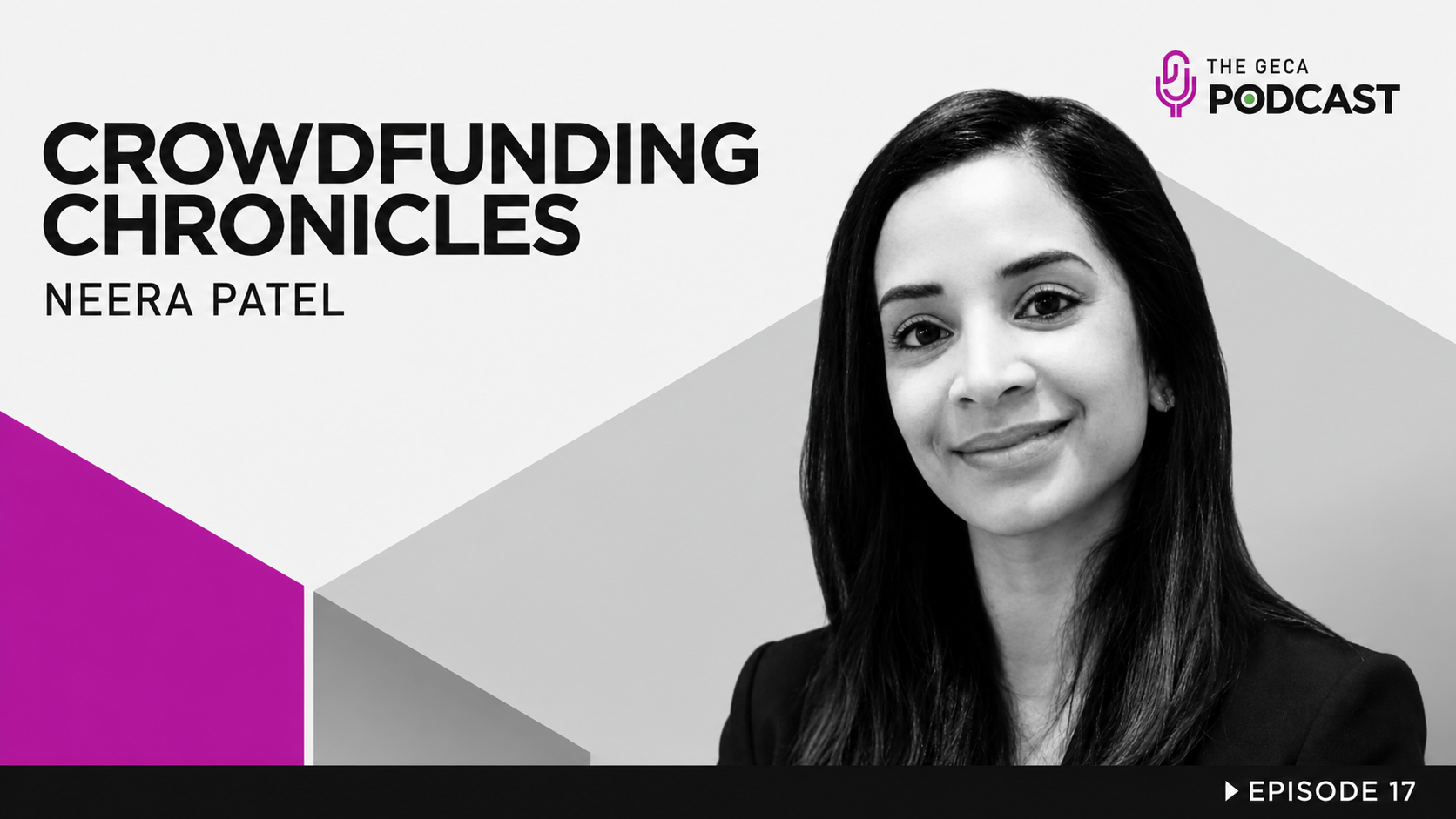
AI Governance in Crowdfunding: Neera Patel on Trust, Audit Trails & the AI Taskforce | GECA Podcast
What if the biggest risk in crowdfunding’s AI revolution isn’t the technology – it’s adopting it without governance?
Agentic AI can now ingest hundreds of pages of deal documents, run regulatory checks, and generate structured reports in minutes – a categorical leap from just two years ago. At the same time, the EU AI Act has come into force, requiring human oversight and audit trails wherever AI touches financial workflows. Platforms that have been quietly experimenting suddenly need to show how they use and govern AI, and the window to get ahead is short. That is exactly why GECA has launched its first industry taskforce: the AI Governance Taskforce, bringing together expertise from across the global crowdfunding ecosystem to define what responsible AI adoption actually looks like. Its newly appointed Chair believes the industry can either shape what good looks like – or have it shaped for them.
Join Andy Field in conversation with Neera Patel, Chair of the GECA AI Governance Taskforce and product lead at Dacxi Chain, whose fintech career includes work on one of the world’s first live central bank digital currencies. From the due diligence bottlenecks that swallow days and weeks to the hallucination traps that have already cost legal firms heavy fines, Neera breaks down what AI compliance really requires in regulated crowdfunding – and why trust, not automation, is the outcome that matters.
Key insights:
- Why AI governance became urgent: agentic AI capability meets the EU AI Act’s human oversight and audit trail requirements
- “Automation is a capability, but trust is actually the outcome” – why every AI decision in regulated finance must be defensible
- Why “the AI said so” is never the answer when a regulator or investor comes asking
- Inside deal preparation today: manual, repetitive cross-referencing that AI can compress from weeks to minutes
- How AI levels the field for smaller platforms with limited legal and compliance resources
- Beyond due diligence: AI in marketing, historic deal analysis, deal selection, and post-deal evaluation
- What governed AI looks like in practice: cited outputs, red-amber-green gap registries, and humans in the loop
- How recorded sign-offs, cryptographic hashing, and blockchain create immutable audit trails regulators can trust
- The hallucination trap: why AI tries to please you, and how unchecked citations have led to heavy fines
- Why one global approach beats 40-50 fragmented AI governance frameworks – and how to get involved in the taskforce
- Crowdfunding in five years: global investor communities, wider deal ranges, and portfolio-style investing
Govern the technology. Keep the human. Earn the trust.
ALSO AVAILABLE ON


AI Governance in Crowdfunding: Neera Patel on Trust, Audit Trails & the AI Taskforce | GECA Podcast
GECA PODCAST VOICEOVER:
Welcome to the GECA Podcast, powered by the Global Equity Crowdfunding Alliance. Dive into the realm of borderless equity crowdfunding, where we bring the world’s top experts and industry leaders directly to you to discuss the innovations redrawing the boundaries of finance. Ready to expand your horizons?
Here’s your host, Andy Field.
ANDY FIELD — HOST:
Hi, everybody. Welcome to Conversations on the Future of Crowdfunding, the podcast from GECA, where we speak with the people shaping the future of crowdfunding and alternative finance around the world.
I’m Andy Field, your host, and I’m delighted to be joined today by Neera Patel, who has just been appointed Chair of the GECA AI Governance Taskforce — a new, industry-wide body helping to shape how our sector adopts AI responsibly.
Neera also leads product at Dacxi Chain and brings a remarkable career in fintech and payments, including work on one of the world’s first live central bank digital currencies.
Today, we’re going to talk about one of the biggest questions facing the industry in the world of AI: how do we harness AI without losing the trust and accountability on which regulated finance depends?
Neera, first of all, congratulations on being appointed Chair of the Taskforce — GECA’s first taskforce — and welcome to the podcast.
NEERA PATEL — GUEST:
Thank you, Andy.
ANDY FIELD — HOST:
It’s a really big deal for GECA as well, because it is our first taskforce. Can you start by telling us exactly what the GECA AI Governance Taskforce is and why the industry needs it now?
NEERA PATEL — GUEST:
Certainly. I’m genuinely excited about this. The Taskforce exists because AI is no longer a future topic for the industry; it is already here. Platforms are making real decisions about how to use it right now, but in my opinion, the industry has lacked a shared framework for doing that responsibly.
The purpose of the Taskforce is to bring together expertise from across the global crowdfunding ecosystem and identify practical, real-world approaches to responsible AI adoption. We’re going to start with a small founding group drawn from different regions, disciplines and organisations.
Over the coming months, we’ll work together to establish our priorities and programme of activity, and then expand participation more broadly across the GECA community.
What I find most exciting is that this isn’t about restricting innovation. It’s about giving platforms the confidence to move forward.
ANDY FIELD — HOST:
That’s great, because GECA supporters will be able to get involved.
AI isn’t new; it has been around for years and, like every discipline, it continues to evolve. What has changed to make AI governance so important now, particularly in crowdfunding?
NEERA PATEL — GUEST:
Two things have converged at the same time.
The first is the technology. With agentic AI, AI no longer just answers questions. In the days of Siri, it was largely about answering questions. What we’re seeing now is technology that can run complex workflows from end to end, and that is categorically different from what existed even two years ago.
These systems can now ingest hundreds of pages of deal documentation, run regulatory checks and flag compliance gaps. They can also generate structured reports in minutes, and you can combine AI with other technologies. The leap in capability is very real.
The second factor is the regulatory environment. We’ve seen the EU AI Act coming into force, with requirements including human oversight and audit trails for AI systems used within financial workflows.
Platforms that may have been quietly experimenting with AI now need to be able to demonstrate how they are using it and how they are governing it. The window to get ahead of that is quite short. The industry can either help shape what “good” looks like or have it shaped for them. That is why the Taskforce exists now. It didn’t exist two years ago because we now have both greater capability and more regulation in place.
ANDY FIELD — HOST:
Fantastic.
When most people hear about AI, they immediately think of automation; the two often go hand in hand. But you often talk about trust instead. Why is trust so important, particularly in crowdfunding?
NEERA PATEL — GUEST:
It is becoming increasingly important because automation is a capability, but trust is the outcome. Without trust, the capability doesn’t matter.
In regulated finance — and crowdfunding is absolutely part of regulated finance — every decision has to be defensible. When a deal goes wrong, a regulator may ask questions or an investor may complain. At that point, saying, “The AI said so,” is not an answer. Someone has to stand behind the decision, with evidence.
The question I always begin with isn’t, “What can AI do?” It is, “What would it take for a regulator or a funder to trust what the AI has produced?”
That question moves you very quickly from automation to governance, auditability and human review: people who can say, “I’ve looked at this, and I stand by it.” That is where trust becomes pivotal. Automation is simply how you build the process efficiently.
ANDY FIELD — HOST:
These are all issues you will bring into the Taskforce’s conversations about how AI can and should be used responsibly in the industry, presumably with the aim of educating and engaging with policymakers, regulators and anyone else who may benefit from its potential output.
From my perspective, it sounds as though AI is becoming part of the core infrastructure — and that is probably happening already.
Moving on to where the industry actually needs it, can you walk us through what happens today when a platform prepares a deal? What are the operational bottlenecks and biggest frustrations compliance teams face that AI could potentially help with?
NEERA PATEL — GUEST:
Today, a deal pack comes in containing the pitch deck, financials, term sheets and multiple other documents, depending on whether the deal is in real estate, energy or another sector.
A deal manager and a compliance officer then evaluate and cross-reference those documents. That can take days or even weeks. A compliance officer or legal team has to read through everything, and the process is both highly manual and repetitive.
They are checking whether everything that needs to be there is present, whether the deal meets regulatory requirements under frameworks such as ECSPR or the FCA, whether the financials are consistent, whether there are red flags, and whether information is accurate or missing.
That creates a great deal of back and forth between the platform and the founder. There are many documents to manage simply to get the deal to launch, and the process can become extremely complex, particularly as deal sizes increase.
There is even discussion of raising the ECSPR cap to €12 million. With a higher cap, the projects coming through are only likely to become more complex.
AI can help address the bottlenecks of time and cost by evaluating deals much faster, cross-referencing information across all the documents, offering assistance and recommendations, citing relevant legal frameworks, and presenting the information quickly so teams can address red-flag areas much sooner.
That means the deal is prepared more robustly before it reaches the legal team, reducing the time and complexity involved in the legal review. It can lower costs for both the deal-management and legal teams and help move a deal to launch much faster.
Investors then gain access to a wider variety of deals. A platform may also be able to handle more deals, potentially supporting revenue growth and providing investors with greater choice. These are all net positives.
ANDY FIELD — HOST:
You’ve used due diligence as one example of where AI could be applied, which I assume is because it relates closely to what you’re working on in your day job: implementing an AI solution for compliance and due-diligence processes.
That is only one application. Smaller platforms often have limited resources across all the areas they need to cover. Do you think AI will change the economics for them? Can it improve efficiency not only in compliance, but also in marketing and the other day-to-day operational activities platforms have to manage?
NEERA PATEL — GUEST:
Yes. We’ve spoken to many platforms, and marketing is another area where AI can add value. Marketing is a significant cost for many platforms. AI can support the marketing process and help ensure a deal is not only compliant but also presented effectively from a sales perspective, highlighting the critical information most likely to capture investors’ attention.
Another area is historical data: looking at deals the platform has handled in the past and analysing what made them successful or unsuccessful. That can help an organisation refine its criteria and quality checks for deal selection.
ANDY FIELD — HOST:
So the management information available to platforms could be greatly improved through the optimal use of AI, making ongoing operations more efficient.
NEERA PATEL — GUEST:
Absolutely. A platform may have a large selection of deals or founders approaching it, along with criteria and quality checks it applies before accepting a deal. AI could support that process and help predict what is likely to happen or whether a deal is likely to succeed.
That supports growth and revenue because the platform can make better-informed decisions. AI can also add value after a deal by examining what happened during and after the campaign. It can use the data captured to evaluate how things might be improved: whether investors took up the deal faster or more slowly, and what could have been changed.
AI could even be used while a deal is live to improve how it is presented to investors, test whether changes increase engagement and refine elements of the narrative.
There are many possible applications, and I am speaking broadly. There will undoubtedly be more. Tax is another area to consider. Many platforms have to manage tax, cross-border requirements and national laws when co-listing. AI can begin to remove some of that complexity and help the industry adapt as it moves forward. It allows organisations to manage complex activities much faster.
ANDY FIELD — HOST:
It makes sense to discuss this at a high level. I’ve spoken to many platforms, and some of the larger ones are already investing heavily in understanding how AI can help their business and operations.
Smaller platforms, however, have limited resources and may not yet have engaged fully with AI. What happens if firms fail to adapt? Where could the industry be in five years if they don’t begin responding to what is happening now?
NEERA PATEL — GUEST:
Smaller platforms clearly have limited resources, and that is precisely where AI can help. I use AI as an assistant to evaluate different things and conduct research, for example.
Similarly, it can help a small deal-management team, or a platform without in-house legal resources, to prepare for legal and regulatory complexities. It can help teams obtain answers much more quickly before they approach an external legal team and incur significantly higher costs.
That allows a platform to overcome some internal barriers, reduce external legal costs and become more efficient. It is about reducing cost while maintaining human oversight.
Smaller platforms can gain a real advantage from being agile and using AI to make the most of the resources they have.
ANDY FIELD — HOST:
Let’s move on to what you’re doing more specifically. We’ve established that AI can help, and that is clearly why the Taskforce has been created. AI is going to play a crucial role in what platforms and other industry stakeholders do.
But we also need to understand what “good AI” actually looks like. That is partly what the Taskforce will bring people together to discuss.
This is also your day job, so help us understand what good AI looks like by explaining what you’re building at Dacxi Chain to address this problem.
NEERA PATEL — GUEST:
At Dacxi Chain, we’re building a service called Dacxi Verify. It is essentially a governed AI-agent platform designed specifically for regulated crowdfunding platforms.
The core idea is that AI reviews a deal. A deal manager uploads the relevant documents, and our agents review the deal by ingesting the entire document pack.
The system runs the documents against our own unique knowledge base, which is tailored specifically for crowdfunding platforms.
ANDY FIELD — HOST:
Is that what makes it different from simply using ChatGPT, Claude or another general-purpose model?
NEERA PATEL — GUEST:
Exactly. We have our own crowdfunding-specific knowledge base, which also incorporates national laws.
The system is instructed to understand deal flows and the workflow itself. It uses that knowledge base to assess the deal against the relevant regulatory requirements. For example, if you are operating under ECSPR in Europe and are based in Germany, it can take the relevant national laws into account as well.
It then produces what we call a validation report. It evaluates and classifies all the documents and creates what we call a gap registry, flagging issues as red, amber or green. It also checks consistency across the documentation, including financial consistency.
The platform then produces a structured, audit-ready report with recommendations and full citations showing where any documents fail to meet their obligations.
The critical point is that AI never makes the final decision. There is always a human in the loop. We have designed it that way because, first, it is essential that the organisation retains control and, second, it supports compliance with the EU AI Act, particularly in Europe.
The platform’s teams and compliance officers can review the output, amend or add missing information, address concerns with the founding company and then re-upload the documents to run the process again. It is cyclical.
ANDY FIELD — HOST:
There is no suggestion that the AI is replacing the human compliance officer, then?
I might use ChatGPT to help plan my daughter’s birthday party, but when people hear “AI and compliance”, they can become nervous. You’ve mentioned the importance of keeping humans in control and that this is part of the EU AI Act and financial-services regulation. How do you make sure that the human genuinely remains in control?
NEERA PATEL — GUEST:
Part of the regulatory requirement is that if we generate a report and everything receives a green status, the user cannot simply press “approve” without meaningful review. The process has to include controls that demonstrate the content and output have actually been examined.
More often than not, an initial upload will probably produce some red flags, which means human intervention is required anyway.
As part of our process, the deal manager reviews everything. Once satisfied, they pass the project through the interface to the compliance officer. We have built sign-off processes into the system.
The platform records and date-stamps who approved the deal and when. Sign-offs may be required from the deal manager, the head of the deals team and the compliance officer. Those approvals are then packaged with the documents in what we call Signet, which acts as a trust layer.
Signet packages the information, hashes it and places the hash on the blockchain so that the record is highly immutable.
ANDY FIELD — HOST:
What does “hashing” mean, for listeners who may not be familiar with it?
NEERA PATEL — GUEST:
It essentially creates a mathematical code for the information. Once the documents have been packaged, hashed and recorded on the blockchain, they can be rehashed whenever they are opened or reviewed. This maintains an audit trail around what has happened.
ANDY FIELD — HOST:
So everything that has been done can be seen?
NEERA PATEL — GUEST:
Yes. If a document is amended, or if new information is uploaded — for example, post-deal information — that can also be hashed. You can see a trail showing what was hashed, who interacted with it and who accessed the data.
In the future, we want to make that package easy to access and share with regulators, funders or co-listing partners.
A platform will be able to share the decisions made with the support of AI, the decisions made about the deal, and the due diligence completed. Other parties will be able to see exactly what steps were taken and what decisions were made.
ANDY FIELD — HOST:
Let’s explore the audit trail a little further. If regulators, funders or others ask what happened during the sign-off process, that information will be available. They will also know that AI was used.
Will they be able to see why the AI reached its conclusion and who subsequently signed it off? In other words, is everything involved in preparing the deal stored, shareable and transparent because of the blockchain record?
NEERA PATEL — GUEST:
Yes, exactly. Our agents will cite the relevant regulation, including any requirement the documents initially failed to meet, and record what was done in response to the recommendation.
A regulator could see that a document ultimately passed and met a particular article or requirement. They would also be able to see the decisions made to correct the issue and ensure it was resolved before publication.
All that information is locked and hashed. They can see whether anyone altered or added to it. There is a historical trail showing how AI was used, which changes were made and who signed the work off. I think that is absolutely critical.
Platforms often save documents in systems such as OneDrive, where it may not always be clear whether somebody adjusted a document, exactly what they changed or when they changed it. That is the type of activity Signet is designed to capture.
ANDY FIELD — HOST:
What you’ve outlined is the difference between AI that performs a task impressively and AI that can stand up to scrutiny. Many people may need to examine that chain or audit trail. That is AI you can trust.
Let’s return to the Taskforce. This is a big job, so well done for taking it on. How will you judge its success? What does success look like, particularly when you are right at the beginning of the journey?
NEERA PATEL — GUEST:
That is precisely the point: we are at the beginning of the journey.
GECA is about bringing stakeholders together from across the world to learn from and share their experiences with one another. The AI Governance Taskforce can bring those stakeholders together to discuss how AI can influence the crowdfunding sector and help advance the ecosystem.
We are at an early stage, but a key ambition is to create global impact. I want us to uncover what the industry genuinely needs in order to continue promoting innovation, make it easier to raise capital, become more efficient and effective, and support everyone within the crowdfunding ecosystem.
Part of the Taskforce’s role is to take information about how the industry uses AI and help inform regulators. We want regulators to understand the industry’s position. People often believe regulation restricts innovation and growth, and balancing those issues has always been a challenge for regulators.
The Taskforce can provide evidence about how the industry believes it can grow, and help inform regulators as they develop the protocols with which we need to comply. That can help ensure decisions are made with the growth of the industry in mind.
One significant measure of success would be the ability to work more closely with regulators before decisions are imposed on the industry.
ANDY FIELD — HOST:
Once the Taskforce is established, has agreed its specific objectives and held those discussions, it will also generate outputs, build relationships with policymakers and regulators, and share its findings. The aim is to ensure these are not simply conversations but discussions that ultimately make a difference.
NEERA PATEL — GUEST:
I believe so, yes. The only way to do that is through collaboration.
ANDY FIELD — HOST:
That leads directly to my next question. GECA has representation around the world, and the Taskforce will be able to take advantage of that. Why is global collaboration so important?
NEERA PATEL — GUEST:
It is important because if every platform develops its own independent approach to AI governance, we could end up with 40 or 50 different approaches, none of which is particularly clear to regulators. That would also create confusion for cross-border partnerships.
If we can help inform some form of common approach or standards for how AI can be used across borders — if that is where the work leads — the Taskforce can influence the direction of the industry.
No single organisation has all the answers, and it is very difficult for any one organisation to address an ecosystem as broad as crowdfunding. The Taskforce brings people together.
It is not only EU-specific, and it is not only equity-specific. Although GECA stands for the Global Equity Crowdfunding Alliance, the work should look more broadly across crowdfunding.
ANDY FIELD — HOST:
You’re absolutely right. GECA does stand for the Global Equity Crowdfunding Alliance, but as more people have become involved, we have opened the conversation to other areas of crowdfunding, including debt and real estate.
Many of the issues GECA is uncovering and discussing apply across the entire sector. Although equity is part of the conversation, we are not talking only about equity here.
NEERA PATEL — GUEST:
Exactly. We’re speaking to people in the United States, Europe and other markets, and across different instruments, including peer-to-peer lending, equity and bonds.
We want to bring everyone together because that is how we will understand the ways AI can help power the ecosystem. The essential question is: how can we use such an important technology to our advantage while also understanding its pitfalls?
There are pitfalls. It is important for us, as an organisation and as a collective Taskforce, to understand the advantages and disadvantages, how to overcome the risks and how the technology relates to each region.
Europe, for example, has a high proportion of peer-to-peer activity, whereas the United States is less focused on peer-to-peer models. Each region has different needs, and we have to consider them.
The Taskforce is about bringing those ideas together so we can collaborate and move the industry forward.
ANDY FIELD — HOST:
And encourage innovation without sacrificing the trust you spoke about. That will be absolutely key.
Why should a platform watching this, or a platform that supports GECA, become involved with and listen to the Taskforce? You’ve already covered much of it, but can you give us a quick summary of why they need to participate?
NEERA PATEL — GUEST:
They need to get involved because many people are currently using tools such as ChatGPT and Claude. They are excellent models, but there are significant issues around hallucination.
Over the course of a conversation, a model can begin to adapt its output in a way that feels as though it is validating your thinking.
ANDY FIELD — HOST:
It tries to please you.
NEERA PATEL — GUEST:
Exactly. I have seen this when using AI. Over time, a thread can become so shaped by your idea that the model makes it seem as though your chosen approach is unquestionably the right one. That influences you. You begin to believe and trust it and think, “This is a great idea.”
But when you examine the citations, you may discover that the source has technically been cited correctly but not in the context you needed.
ANDY FIELD — HOST:
The citation may be accurate, but the context is wrong.
NEERA PATEL — GUEST:
Exactly, and I think that risk is often overlooked. AI can convince people very quickly and easily.
We have seen examples in the legal sector where firms have used AI-generated material and it has passed through a chain of people — from one legal team to more senior reviewers — without anybody properly checking it. They have all approved it without recognising the hallucinations, and firms have subsequently faced significant penalties.
ANDY FIELD — HOST:
You told me about this when we were at the conference in Malaga recently. You raised it as a potential pitfall and warned that we need to be careful. The same thing simply cannot be allowed to happen in financial services.
NEERA PATEL — GUEST:
It can happen, which is why organisations must not be fooled by it. It is very easy to believe what you are reading, and people do not always take the time to check every citation. That is a critical issue.
The Taskforce is also about exploring how AI can be used effectively. We’ve spoken with platforms that have identified a wide range of potential use cases and ways the technology might benefit them.
By sharing ideas, we can understand which applications add the greatest value to an organisation — whether that is moving a deal through the funnel faster, analysing deals before launch, or examining historical deal performance.
Platforms can learn from all these applications. Their teams can become better informed and more capable of identifying the right deals: deals that may generate stronger revenue while also meeting investor demand.
It is about learning as much as possible from other people’s experience, understanding the advantages and disadvantages, and seeing how each platform can benefit. Sharing ideas is a very valuable way to learn.
ANDY FIELD — HOST:
That will certainly be our message to GECA supporters: when we put out the call, get involved as much as possible.
We only have a couple of minutes left, so I’m going to ask you two quick questions. First, what do you think the crowdfunding industry will look like in relation to AI five years from today?
NEERA PATEL — GUEST:
Crowdfunding has been around for more than 20 years, and it is a powerful way for economies to encourage entrepreneurship and support innovation globally.
I expect platforms will increasingly be able to raise capital from a global investor community rather than only from domestic investors. I think that is where the industry is headed.
There will also be a wider range of deals than we have today, and the whole experience will become more streamlined and transparent. Investors may even be offered packaged deals, a little like the portfolios available through traditional investment firms. That may be one direction the industry takes in the future.
ANDY FIELD — HOST:
Interesting — and AI can only help with that.
To finish, what is the one message you would like every crowdfunding platform to take away from today’s discussion?
NEERA PATEL — GUEST:
The one message is that trust is not the enemy of speed. Platforms that govern their AI well will move faster and further than those that do not.
Trust is not the enemy of speed. It can enhance your credibility and help you access markets.
ANDY FIELD — HOST:
Fantastic. Trust is absolutely crucial to everything we are going to discuss from an AI perspective.
Neera, thank you very much. That was a brilliant conversation.
To summarise, technology changes industries, but trust transforms them. If we are going to use AI, we need trust, credibility and auditability so that decisions and actions can be checked.
Keeping the human in the loop is extremely important, and the scrutiny will be there for all the reasons we have discussed. Hopefully, the Taskforce can bring people together and develop recommendations that help make responsible adoption possible.
To our listeners, thank you for tuning in. If you care about what this industry is doing, where it is going and how we govern the technology shaping it, keep an eye on the GECA AI Governance Taskforce, because there is a great deal to come. Neera will also be very happy to speak with you.
Conversations like this are exactly why GECA exists: to bring together diverse global perspectives, challenge fragmented thinking and help shape a more connected and inclusive crowdfunding ecosystem — not only in equity crowdfunding, but across the sector.
Stay with us for future episodes as we continue to explore the people, policies and platforms unlocking crowdfunding without borders.
Don’t forget to follow us for more conversations with the people shaping the future of crowdfunding, and visit thegeca.org to learn more about our mission, our growing global supporter base and how you can get involved.
Thanks again, Neera. It has been a fantastic conversation, and we’ll see you all soon.
Share this article


[End of Transcript]